




Key Takeaways
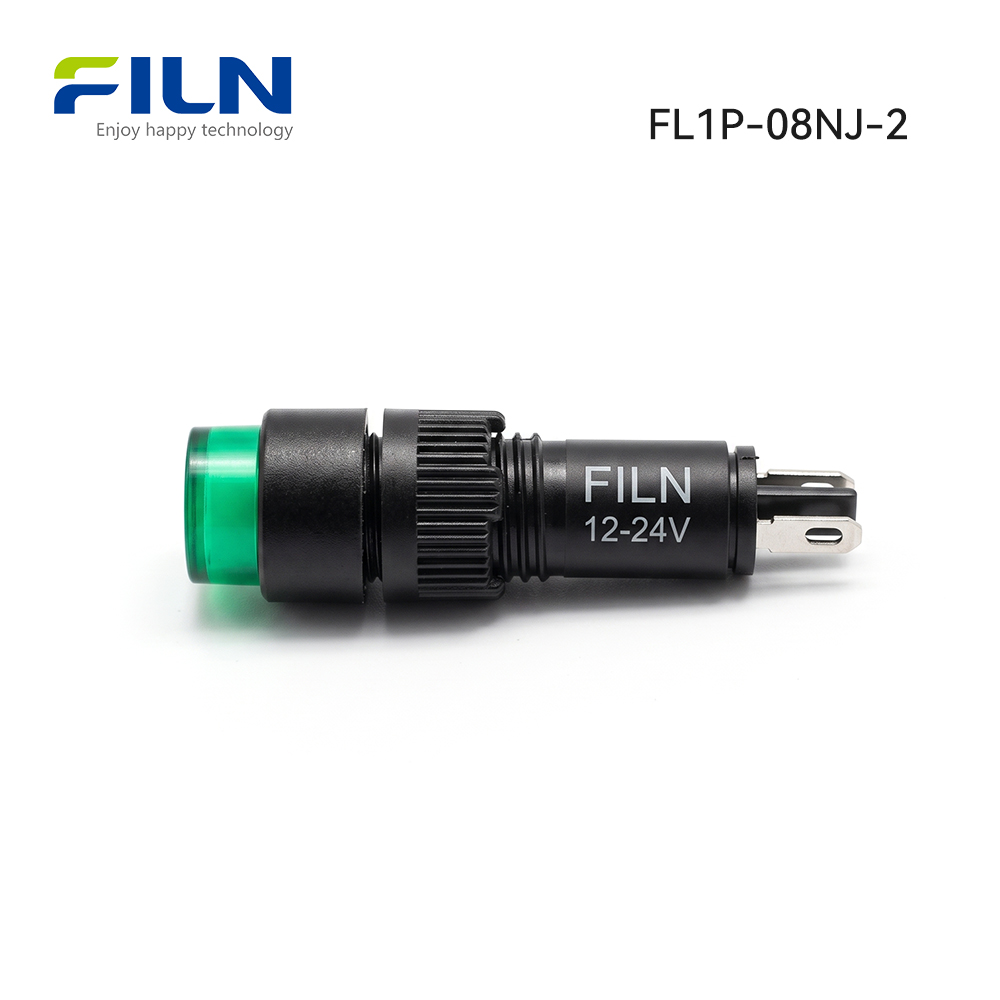
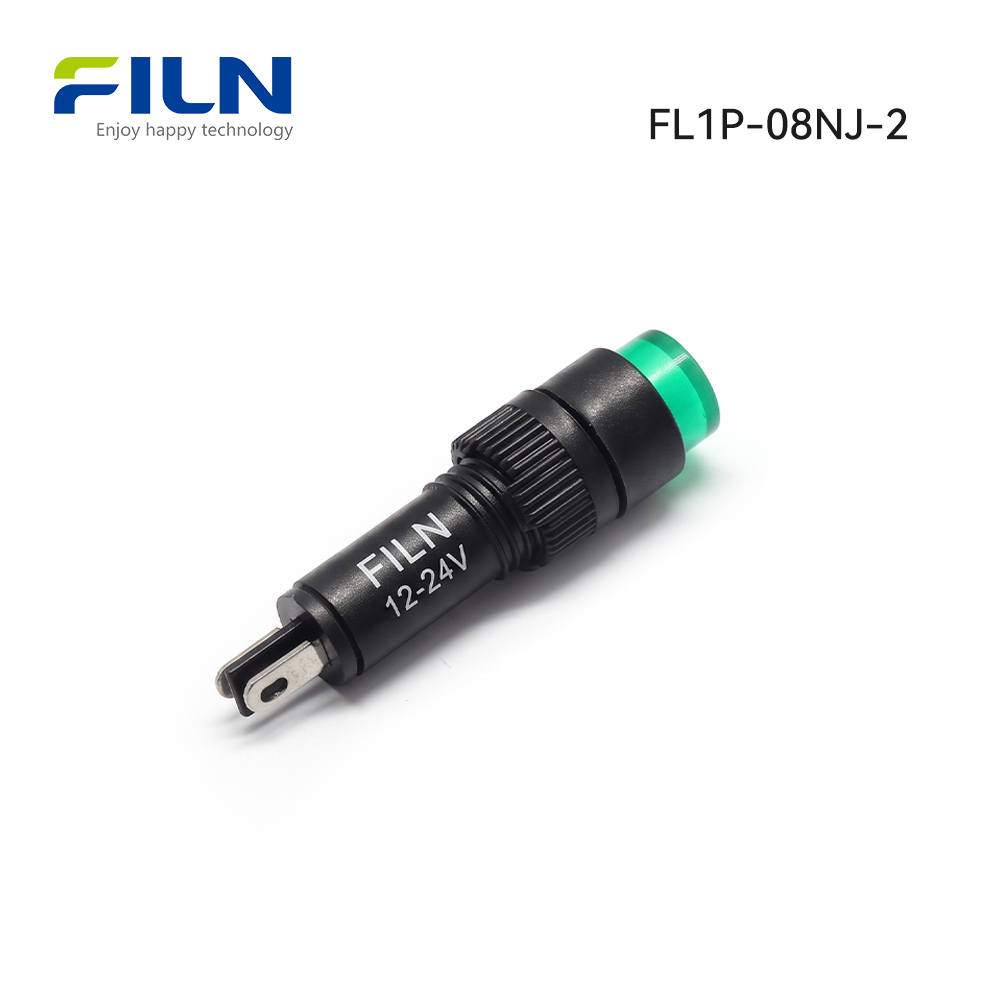
- This page covers FILN LED signal lamps in an 8mm circular high-head plastic format with 2PIN pin terminals (model FL1P-08NJ-2).
- These LED signal lamps are lighter and typically more cost-efficient than comparable metal-bodied lamps for indoor industrial equipment panels.
- Mounting hole diameter for these LED signal lamps is 8mm; installation is threaded, using the matching plastic nut tightened from the rear after front insertion.
- Wiring on these LED signal lamps is 2PIN plastic pin terminals — not a factory wire-lead length on this page.
- Voltage for these LED signal lamps is customizable from 3–480V; confirm AC or DC and the exact rating on every RFQ.
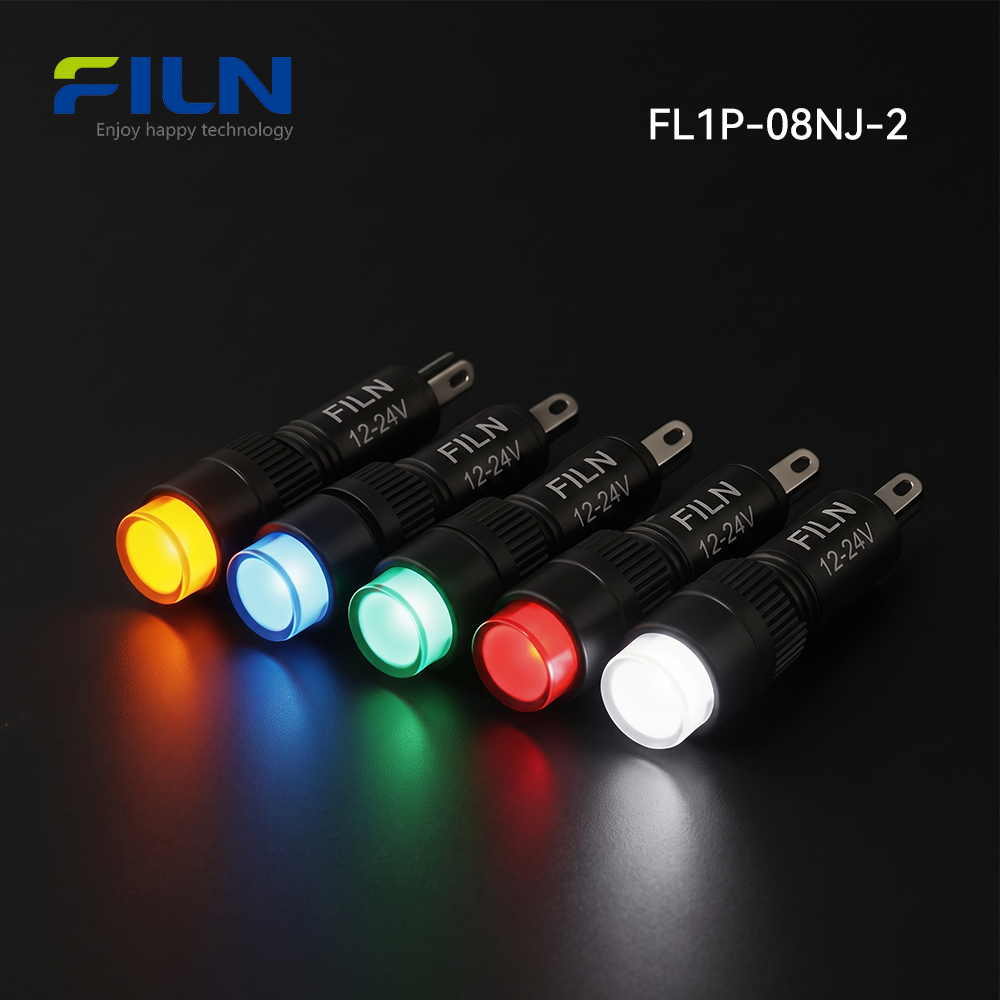
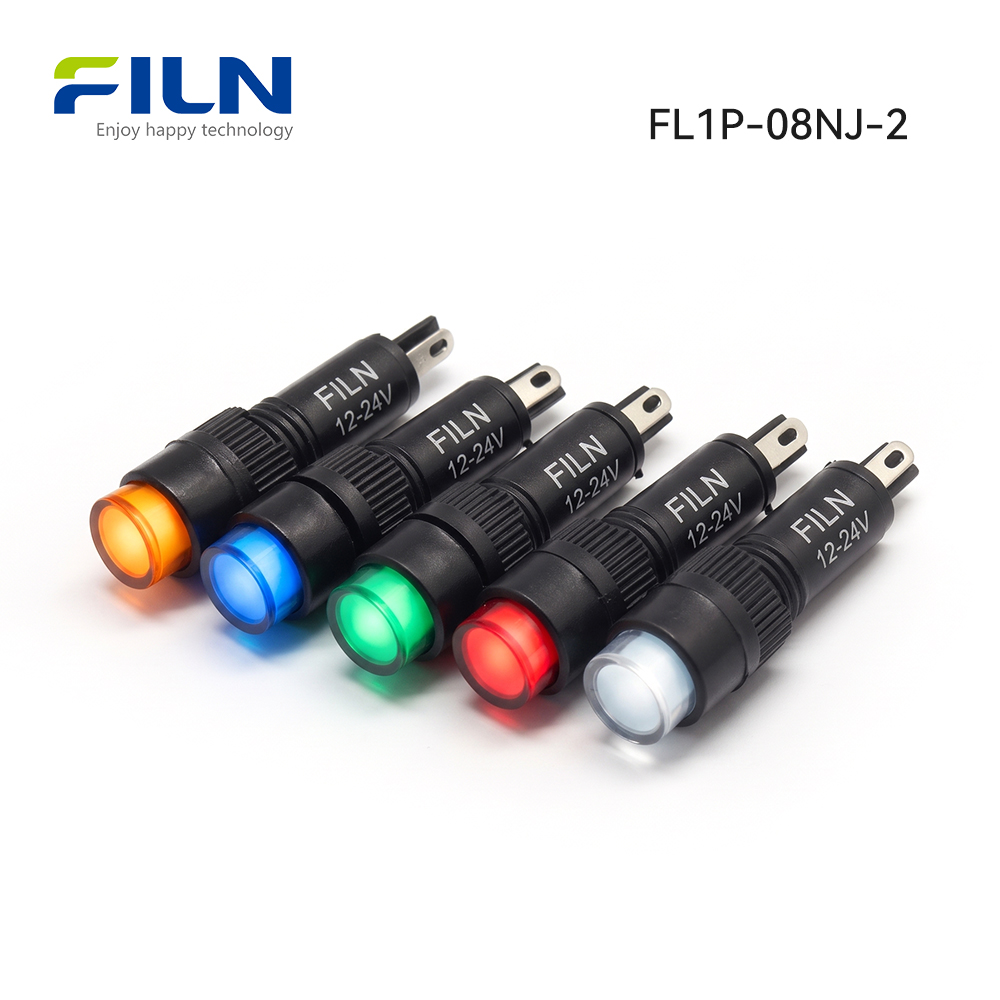
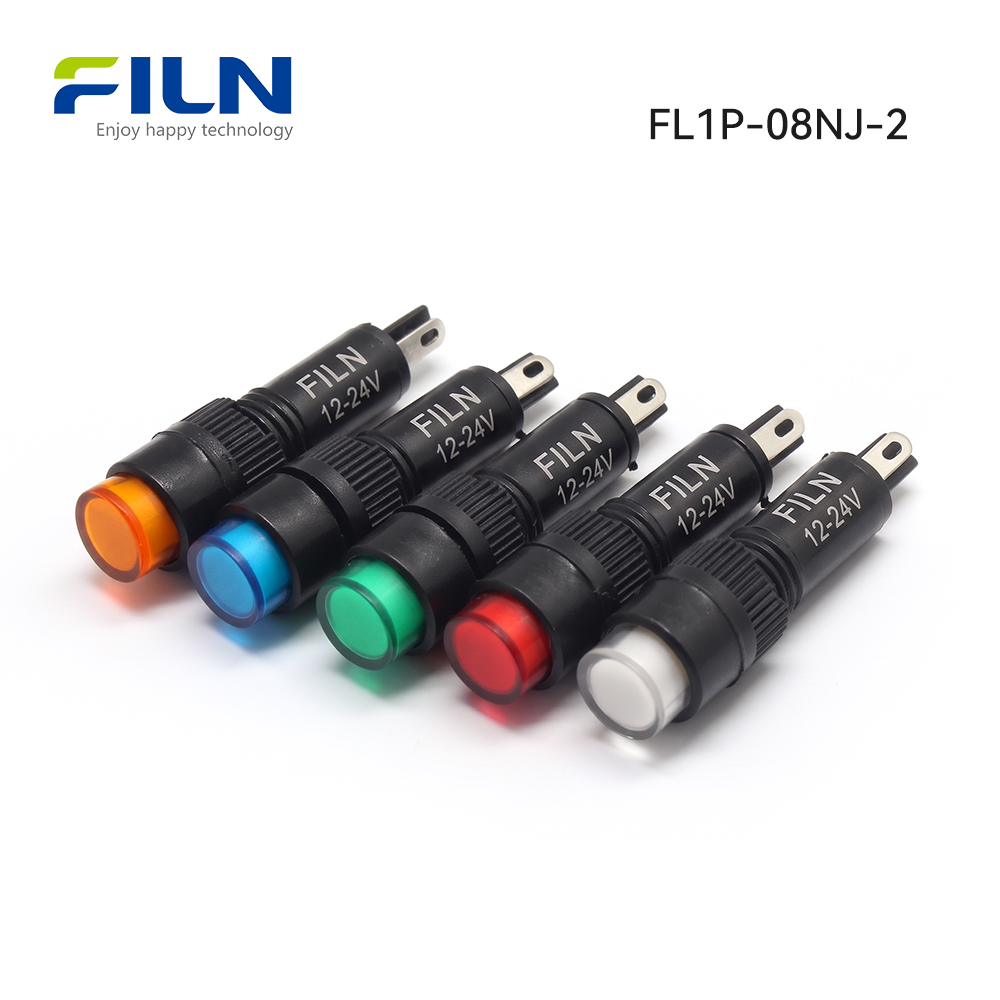
- LED colors available for these LED signal lamps: Red, Green, Yellow, Blue, and White (R/G/Y/B/W).
- Product marks stated for this offering: CE, VDE, RoHS, and CCC. ISO9001 is the company quality system. Request certificates for the exact build.
- Package contents for these LED signal lamps: 1× plastic indicator light (high-head lamp with matching plastic nut) as described here.
- Polarized LED beads and non-polar LED beads can both be supplied; non-polar builds of these LED signal lamps can be wired without observing polarity.
- Series-typical electrical and climate figures (≤20 mA, approx. 0.2 W, IP50, −15°C to +80°C) are configuration-dependent and must be confirmed with FILN.
- FILN is the factory brand of Yueqing Yulin Electronic Co., Ltd., supporting OEM/ODM, samples, datasheets, and 3D/CAD requests for B2B buyers in the US, Canada, Germany, UK, and Australia.
- Use the RFQ checklist below when you need a quotation, sample, datasheet PDF, or mechanical model for these LED signal lamps.
What Is a Plastic Indicator Light?
A plastic indicator light is a panel-mounted optical status device that uses an LED inside an insulating polymer housing to show machine state. In industrial catalogs it is also called a plastic LED pilot light or a plastic panel indicator. FILN produces this category as factory-made LED signal lamps for buyers who need a clear, compact status cue on equipment fronts.
The function of LED signal lamps is simple and critical: convert an electrical presence or logic signal into a visible color cue for operators and service technicians. Engineers place LED signal lamps where power-on, run, fault, or mode status must be read at a glance without opening the enclosure.
Structure typically includes a lens or head, a PA66 plastic shell and base, an LED emitter, a current-limiting resistor, and a wiring interface. On these 8mm LED signal lamps, the interface is a 2PIN pin terminal rather than a pre-wired lead or a screw terminal block, and retention is by a matching plastic nut.
Purpose and industrial value center on reliable human-machine feedback. Correctly specified LED signal lamps reduce mis-operation, speed troubleshooting, and standardize status language across a product family. Plastic housings cut weight and material cost versus metal barrels when the environment does not require a metal bezel.
Operating principle of these LED signal lamps: rated voltage is applied across the LED path; the resistor sets current; photons exit through the circular high head. DC builds of these LED signal lamps may use polarized or non-polar LED beads according to the ordered option. AC builds of these LED signal lamps must match the named voltage and 50/60 Hz where applicable.
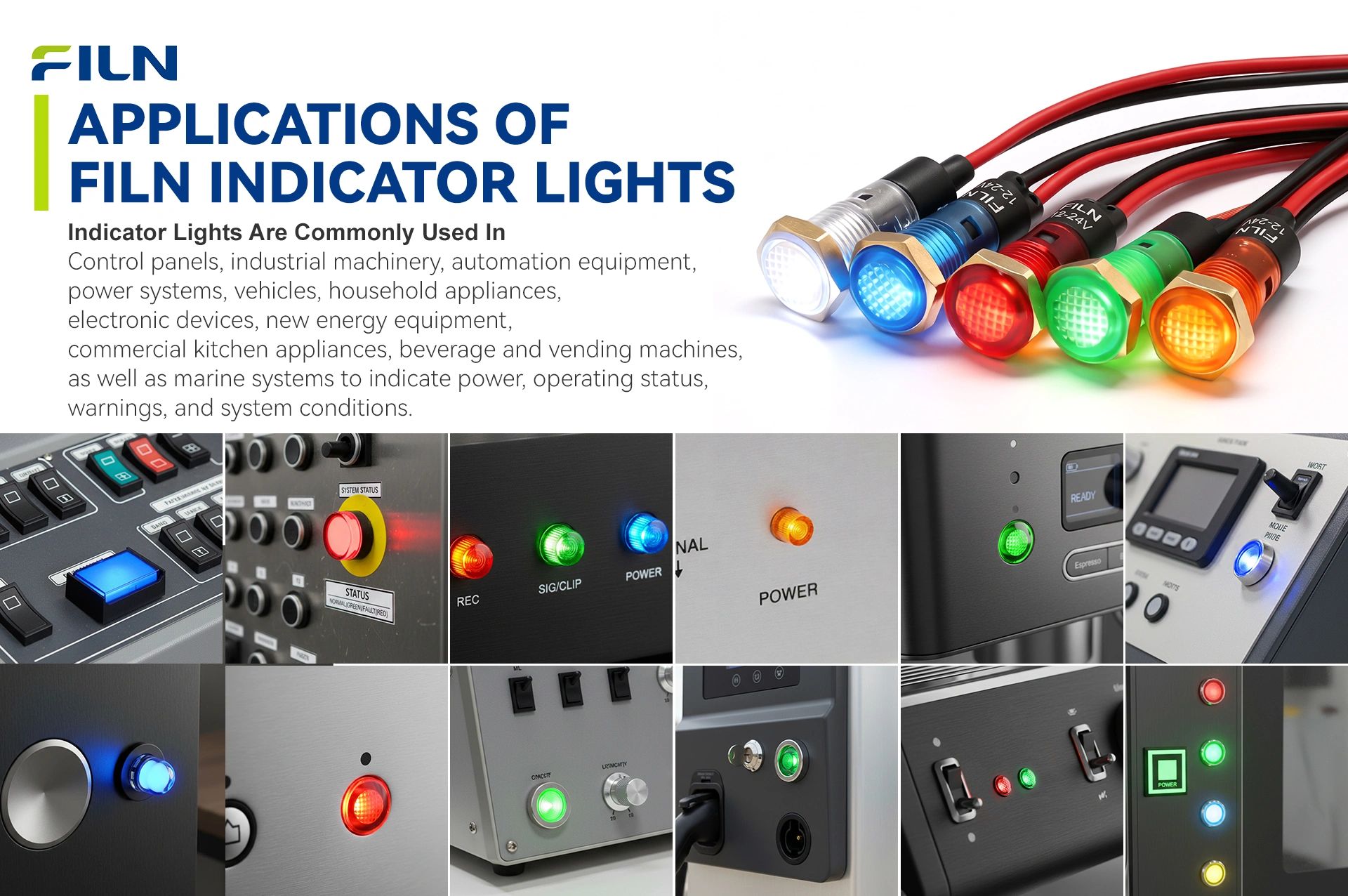
Typical applications for plastic LED signal lamps include large electrical equipment, laboratory and test instruments, distribution cabinets, new-energy systems, yacht electrical panels, household appliances, automotive modification projects, light machinery, commercial self-service equipment, and other machines that need a compact status lamp.
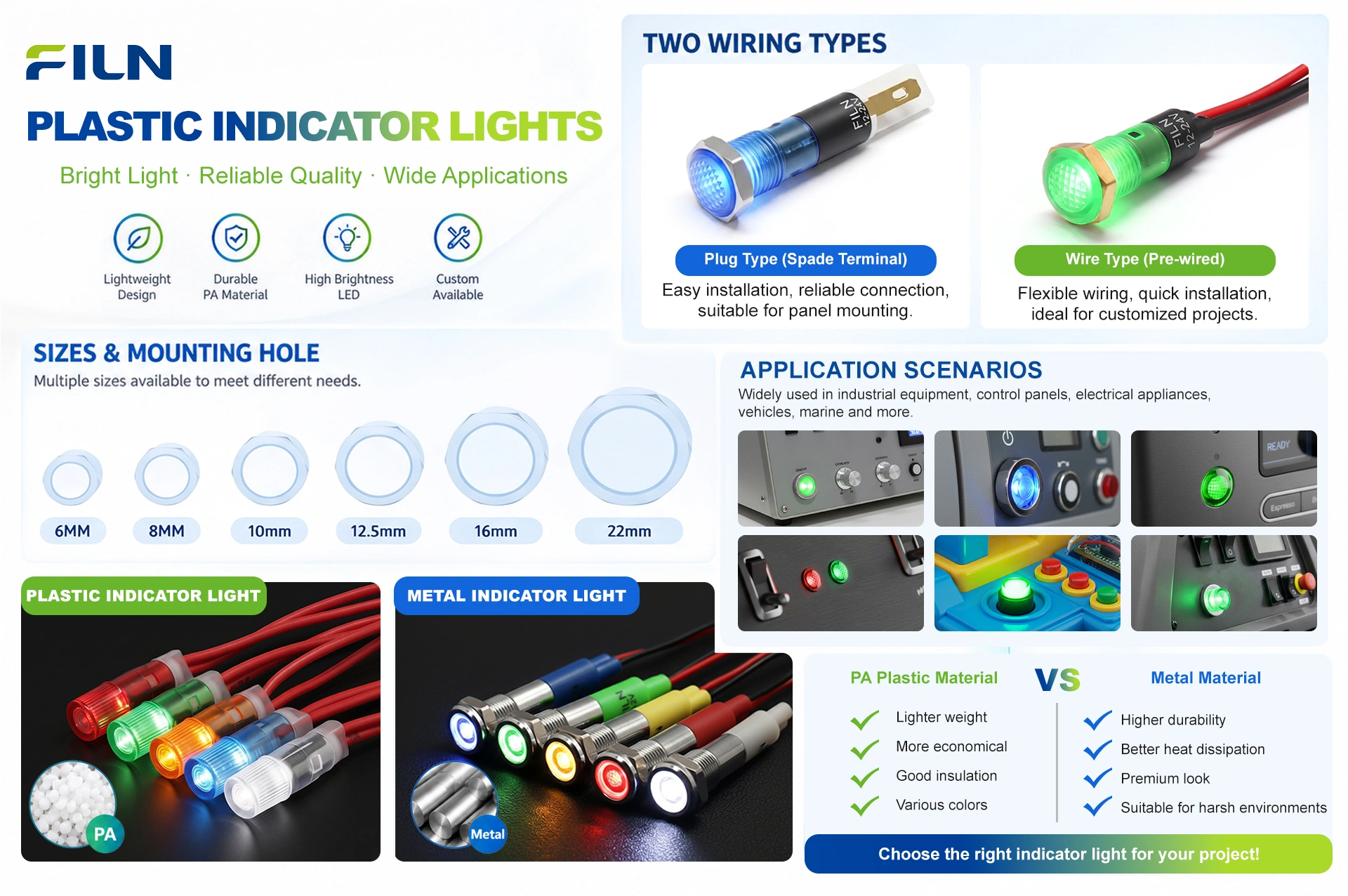
Category context: buyers usually compare metal indicator lights with plastic indicator lights. Metal bodies suit harsher fronts and certain aesthetic standards; plastic bodies suit weight-sensitive, cost-sensitive, and high-volume OEM panels. FILN plastic sizes commonly discussed in the family include 6mm, 8mm, 10mm, 12mm, 16mm, and 22mm. Colors are Red, Green, Yellow, Blue, and White. Plastic wiring methods include pin-type, pre-wired wire-lead, and screw-terminal versions. This page focuses on 8mm circular high-head LED signal lamps with 2PIN pins and plastic-nut mounting. Metal families may also offer flat, convex, or concave heads for reference; the plastic focus here is size, color, head height, and termination.
| Request a Sample | Buy This Indicator |
| Request Datasheet PDF | Request 3D Model / CAD |
Open Full Category →
Opens in a new window for related sizes and wiring styles, including other LED signal lamps in the plastic family.
More 6mm plastic indicator lights →
Procurement teams comparing LED signal lamps across hole sizes can keep this 8mm high-head nut-mount page and the 6mm category open side by side while they freeze the panel cutout.
If your drawing still lists a metal barrel, ask whether these plastic LED signal lamps can meet the same indication duty at lower mass before you tool a new front.
Product Overview
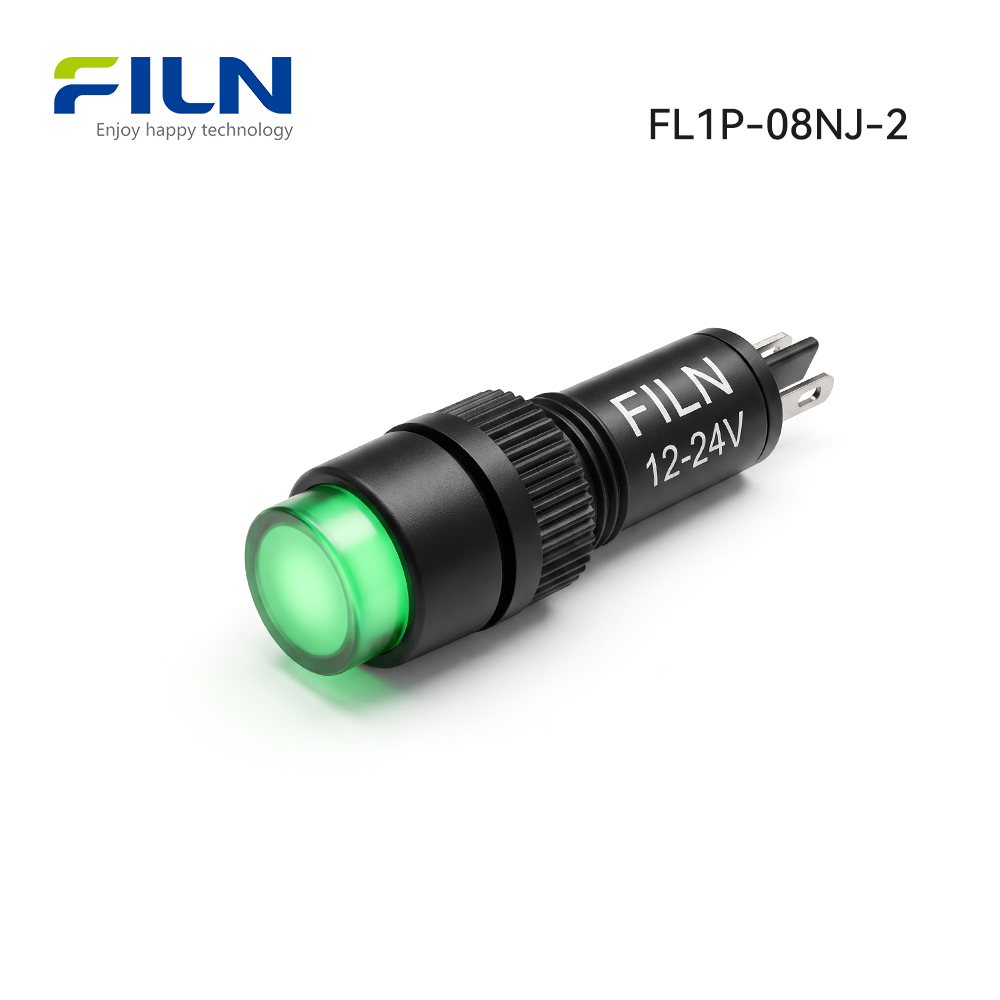
FILN model FL1P-08NJ-2 describes factory LED signal lamps in a common 8mm circular high-head plastic body. After installation, the operator sees these LED signal lamps as a round, bright, easy-to-read lamp on the panel, while the 2PIN pins remain behind the sheet for electrical connection.
Mechanically, these LED signal lamps pass through an 8mm hole from the front. A matching plastic nut is then rotated upward from the rear until the head of the LED signal lamps is clamped square to the panel. This threaded method is familiar to panel shops that already use nut-mount LED signal lamps.
Electrically, a current-limiting resistor is paired to the ordered voltage so the LED in these LED signal lamps stays inside a safe current window. Because voltage is customizable from 3–480V, each build of these LED signal lamps must be treated as a controlled configuration rather than a universal spare.
Industrial advantages of these plastic LED signal lamps include lower mass than comparable metal indicators, practical heat resistance for typical indoor equipment use, and a cost profile suited to volume OEM fronts. The design is widely used across industries that need straightforward LED signal lamps rather than a metal-bezel aesthetic.
Certifications stated for this offering are CE, VDE, RoHS, and CCC as product marks, with ISO9001 as the company quality system of Yueqing Yulin Electronic Co., Ltd. Buyers should request certificates for the exact build of these LED signal lamps rather than assuming a file from another voltage or color automatically applies.
The housing family is series-typical Nylon PA66. Materials, series-typical electrical limits, and climate figures are tabulated in the sections that follow so engineering and purchasing can review LED signal lamps with the same data pack.
To proceed from overview to a controlled buy-off, open the catalog product page or send an RFQ for these LED signal lamps.
Quick Specifications
The following table lists the product facts supplied for these 8mm LED signal lamps (model FL1P-08NJ-2). Values marked series-typical in later sections are not repeated here as unique hard facts for these LED signal lamps.
| Item | Specified value |
|---|---|
| Brand / manufacturer | FILN (Yueqing Yulin Electronic Co., Ltd.) |
| Model (body / specs / FAQ reference) | FL1P-08NJ-2 |
| Product type | Plastic LED signal lamps, 2PIN pin-terminal type |
| Mounting hole | 8mm |
| Head type | Circular high-head (round high-profile) plastic indicator |
| Wiring method | 2PIN pin terminals (plastic pin-type; not a wire-lead SKU) |
| Mounting method | Threaded installation with matching plastic nut |
| Voltage | 3–480V customizable; confirm AC/DC and exact rating on the RFQ |
| LED colors | R/G/Y/B/W — Red, Green, Yellow, Blue, White |
| Polarity options | Polarized (positive/negative) LED beads or non-polar LED beads, as ordered |
| Accessories / pack | 1× plastic indicator light (includes the matching plastic nut used to clamp the lamp) |
| Installed appearance | Circular lamp on the panel, bright and easy to see, with 2PIN pins behind the panel |
| Product marks stated for this offering | CE, VDE, RoHS, CCC (request certificates for the exact build) |
| Company quality system | ISO9001 |
| Typical application scope | Large electrical equipment, laboratory/test equipment, distribution cabinets, new energy, yachts, household appliances, automotive modification, and other equipment needing signal indication |
Use this drawing to check the high-head profile and pin geometry of these LED signal lamps against your panel thickness and rear clearance. The image is intentionally constrained so the specification tables for these LED signal lamps remain easy to read.

If a tolerance on the drawing is unclear, ask FILN for a datasheet or 3D model of these LED signal lamps before you release the punching program.
Do not infer a default voltage, wire length, or pin plating detail for these LED signal lamps from the drawing alone; those items belong on the RFQ.
Incoming quality teams can attach this specification table to the inspection instruction used for LED signal lamps so each lot is checked against the same field list.
Performance Parameters
Electrical and protection figures in the table below are series-typical for FILN plastic LED signal lamps. They must be confirmed for the exact voltage and color of the ordered LED signal lamps and should not be copied onto a drawing as unique, unverified SKU facts.
| Parameter | Series-typical or stated value |
|---|---|
| Rated operating voltage (order-defined) | Customizable 3–480V; confirm AC or DC and exact rating (50/60 Hz for AC) |
| Rated operating current (series typical) | ≤ 20 mA |
| Rated power (series typical) | Approx. 0.2 W |
| Insulation resistance (series typical) | ≥ 100 MΩ at 500 V DC between leads/pins and housing |
| Dielectric strength (series typical) | 1500 V AC — no breakdown or flashover under the stated test |
| Operating life (series typical) | 60,000 hours |
| Ingress protection (series typical) | IP50 (do not assume IP65 or IP67) |
| Product marks stated for this offering | CE, VDE, RoHS, CCC — request certificates for the exact build |
| Company quality system | ISO9001 |
For export documentation, ask FILN to attach the certificate set that corresponds to the shipped lot of LED signal lamps. Company-wide capability marks are not a substitute for the file tied to your exact voltage and color configuration of LED signal lamps.
| Request Quotation / Spec Confirmation |
Incoming inspection can sample-illuminate LED signal lamps at the named voltage and record color against the purchase-order line.
Insulation and dielectric series-typical values help electrical safety reviewers compare these LED signal lamps with alternate lamp technologies.
Record lot numbers for every release of LED signal lamps so a field complaint can be traced to the exact voltage and color build.
Component Materials
Material selection for these plastic LED signal lamps prioritizes insulation, heat resistance, flame retardancy, low mass, and cost efficiency. The table lists series-typical bill-of-materials items used across FILN plastic LED signal lamps, with the plastic nut included because this is a threaded nut-mount design.
| Component | Material / type | Why it matters |
|---|---|---|
| Shell / base / lens | Nylon PA66 (series typical) | Electrical insulation, heat resistance, light weight, economical for OEM volume |
| Light source | LED, polarized or non-polar per order (series-typical 5mm package where applicable) | Defines color, brightness, and wiring polarity rules |
| Current limiting | Carbon film resistor (series typical) | Sets safe LED current for the rated voltage build |
| Pin terminals | 2PIN plastic pin-type interface (this SKU) | Provides a compact rear connection without a factory wire lead |
| Plastic nut | Matching plastic nut for threaded clamp (this design) | Locks LED signal lamps to the panel from the rear after front insertion |
| Wire lead | Not applicable on this pin-type SKU | Do not assume a factory lead length or AWG for these LED signal lamps |
PA66 on these LED signal lamps keeps the illuminated head electrically insulated from the panel skin in normal indoor builds, including many distribution-cabinet doors.
Resistor selection inside the LED signal lamps is paired to the ordered voltage; do not swap heads across voltage bins in the stockroom.
If a drawing calls for a special nut color, anti-rotation feature, or pin length, state that requirement in the RFQ for these LED signal lamps rather than assuming a default.
Warehouse labels for each configuration of LED signal lamps should spell out voltage, AC/DC, and color in large type.
Environmental Performance
Environmental figures are series-typical for FILN plastic LED signal lamps and must be confirmed for the exact FL1P-08NJ-2 voltage and color build. They describe the climate window in which LED signal lamps are expected to remain functionally stable under stated laboratory tests.
| Item | Series-typical value |
|---|---|
| Operating & storage temperature (series typical) | −15°C to +80°C |
| Operating relative humidity (series typical) | ≤85% at +40°C |
| High-temperature test (series typical) | 96 h at 80±2°C |
| Low-temperature test (series typical) | 96 h at −15±2°C |
| Constant temperature/humidity (series typical) | 96 h at 40±2°C, 90%–95% RH |
| Temperature cycling (series typical) | −15°C 30 min / 80°C 30 min, 5 cycles |
| Ingress protection (series typical) | IP50 |
Outdoor wash-down, marine salt fog, or higher ingress requirements may need a different family of LED signal lamps or an added sealing strategy. This page does not claim IP65 or IP67 for the FL1P-08NJ-2 plastic nut-mount body used on these LED signal lamps.
Climate chamber data for the series informs storage rules for spare LED signal lamps in non-conditioned warehouses.
If the end equipment sees wash-down, ask FILN for a different sealed family rather than assuming these LED signal lamps are watertight.
Qualitative heat resistance is adequate for many indoor industrial fronts, but always stay inside the series-typical temperature window confirmed for the shipped LED signal lamps.
LED Specification
Color and polarity options for these LED signal lamps are listed below. Per-color electro-optical numbers such as forward voltage, reverse current, luminous intensity, dominant wavelength, and viewing angle are configuration-dependent and are not invented on this page. Confirm those values with FILN for the ordered build.
| LED item | What this page can state |
|---|---|
| Available colors | Red, Green, Yellow, Blue, White (R/G/Y/B/W) |
| Polarized LED beads | Available; observe positive and negative orientation on DC circuits |
| Non-polar LED beads | Available; LED signal lamps with this bead type can be wired without observing polarity |
| Dual-color / tri-color | Available where applicable; confirm with FILN — not implied as standard on this SKU |
| Electro-optical numeric table (VF, IR, Iv, wavelength, angle) | Not stated as a unique fact here; request the configuration-specific datasheet |
| Series-typical current / power context | See Performance section (≤20 mA / approx. 0.2 W, configuration-dependent) |
When a legend plate already assigns meaning to each color, order LED signal lamps to that legend rather than substituting colors in the warehouse.
Optical samples of LED signal lamps can be requested so industrial designers can judge on-panel brightness under expected ambient light. Request a color sample when the front appearance is critical.
| Request Datasheet PDF | Request a Sample |
Do not mix polarized and non-polar lots of LED signal lamps in one bin; the wiring rule is different.
Standard Test Conditions
Unless a customer specification says otherwise, series-typical laboratory checks for FILN plastic LED signal lamps are performed in a standard test atmosphere. Confirm the applicable procedure when you need a formal test report.
| Condition | Series-typical value |
|---|---|
| Ambient temperature | 5°C to 35°C |
| Relative humidity | 45%–85% |
| Air pressure | 86–106 kPa |
| Notes | Photometric or color measurements, when provided, should follow the calibration and tolerance notes on the issued datasheet or report |
Incoming inspection of LED signal lamps should either reproduce this atmosphere or record any departure so brightness judgments stay comparable lot to lot.
If a customer audit requires a witnessed test of LED signal lamps, state that need early so FILN can confirm laboratory availability and the exact method.
Do not treat a bench check in an uncontrolled workshop as a substitute for the series-typical atmosphere when you are qualifying a new color of LED signal lamps.
Applications by Industry
Plastic LED signal lamps are used wherever an operator or technician must read equipment state quickly. The themes below rewrite the approved application scope in natural English for B2B buyers. They do not upgrade IP, temperature, or lifetime beyond the series-typical data pack.
Large electrical equipment and light machinery. Builders mount 8mm LED signal lamps on control skins to show power, run, and fault states. The high-head lens stays readable on crowded fronts, and the plastic body keeps added mass low.
Laboratory and test equipment. Benchtop and rack instruments use LED signal lamps to show ready, busy, or limit conditions. Pin-type exits help keep shallow rear cavities tidy when a short jumper or socket is planned.
Distribution cabinets and power distribution. Cabinet doors often need compact LED signal lamps at an 8mm hole for phase presence, trip indication, or mode status. Confirm voltage and AC/DC carefully on mains-referenced doors.
New-energy equipment. Inverter skids, charging hardware, and related assemblies use LED signal lamps for isolator state and alarm cues. Specify the environment honestly; this family is series-typical IP50, not a wash-down rating.
Yachts and marine-adjacent electrical panels. Interior yacht panels sometimes adopt plastic LED signal lamps for lighting and system status. Salt-fog or wet-deck duty may require a different sealed product; ask FILN rather than assuming this body is sufficient.
Household appliances and consumer equipment. High-volume appliance fronts use LED signal lamps where a bright circular cue is enough and a metal bezel is unnecessary. Custom voltage and color support OEM platform reuse.
Automotive modification and light-vehicle interiors. Builders use compact LED signal lamps for accessory status. Confirm DC rating, polarity option, and environment; this page does not present the lamp as an exterior road-legal lighting device.
Compared with metal indicators, these plastic LED signal lamps are typically lighter and more economical for indoor or protected panels. Choose metal when the specification calls for a metal bezel, a harsher front, or a different mechanical standard. Do not assume a higher IP rating simply because a metal alternative exists.
If your industry is not named above but still needs panel status, describe the environment in an RFQ and FILN can help confirm whether these LED signal lamps are an appropriate starting point.
Browse all panel indicator lights when you are comparing hole sizes, or keep more 6mm plastic indicator lights open if the cabinet already uses a smaller cutout.
LED Indicator Color Meanings and Application Guide
Color conventions for LED signal lamps vary by OEM, industry, country, and machine design. Use the notes below as a starting point, then lock meanings on the equipment legend plate so operators are not left to guess.
Red. Commonly used for fault, alarm, emergency-stop chain active, or danger presence. Typical panel use includes stop lamps and over-temperature alerts. Confirm whether a steady or blinking pattern is required.
Green. Commonly used for normal run, ready, or healthy power. Typical panel use includes run status and enable-confirmed cues. Avoid using green for fault in most markets.
Yellow / Amber. Commonly used for warning, standby, or a transitional state. Typical panel use is attention without a full alarm. Define the escalation path versus red clearly.
Blue. Often reserved for a special mode, remote control, or an auxiliary function. Document the meaning on the legend plate, because blue is less standardized than red or green.
White. Often used for neutral illumination, power present, or an unmarked status. Pair white LED signal lamps with printed legends so the cue remains unambiguous.
| Color | Common meaning | Typical panel use | Selection note |
|---|---|---|---|
| Red | Fault, emergency-stop chain active, alarm, danger presence | Stop / alarm lamps, over-temp alerts | Confirm if blinking patterns are required |
| Green | Normal run, ready, power healthy, safe to proceed | Run status, enable confirmed | Avoid using green for fault in most markets |
| Yellow / Amber | Warning, standby, transitional state | Attention without full alarm | Define versus red escalation clearly |
| Blue | Special mode, remote control, auxiliary function | Maintenance mode, custom OEM states | Document meaning on the legend plate |
| White | Neutral illumination, power present, unmarked status | General indication, backlight-like cues | Pair with printed legends for clarity |
Dual-color or tri-color LED signal lamps may be discussed where applicable, but they are not implied as standard on this SKU. Confirm any multi-color need with FILN.
When exporting equipment, review whether the destination market expects a different color language before you freeze the bill of materials for LED signal lamps.
If you need help mapping a legend to order codes, send the legend with your RFQ.
Installation Guide
Installation of these 8mm LED signal lamps is a threaded, plastic-nut method. Always isolate power before cutting, inserting, or wiring these LED signal lamps. Confirm panel thickness and rear nut clearance against the product drawing or a FILN datasheet before volume assembly. Installation details can vary by exact build, so treat the steps below as the standard method for model FL1P-08NJ-2 unless FILN states otherwise.
Tools and preparation. Use a correctly sized punch or drill for a clean 8mm round hole, a deburring tool, a panel-safe wrench or fingers for the plastic nut, and a multimeter. Keep the lens of the LED signal lamps free of cutting chips and paint overspray.
Hole requirements. Cut a matching circular 8mm opening at the coordinates shown on the mechanical drawing. An oversized hole weakens nut clamp load on LED signal lamps; an undersized or out-of-round hole tilts the high head.
Orientation. Decide pin orientation before tightening so the 2PIN exit lines up with the planned socket, PCB, or jumper path. The circular high head should sit square and fully visible on the operator side.
- Cut a matching round 8mm hole in the product panel and deburr both sides of the cutout.
- Insert the lamp from the front (operator side) of the panel into the opening, keeping the high head square to the surface.
- From the rear of the panel, thread the matching plastic nut onto the body and rotate it upward toward the panel until the lamp is firmly clamped without cracking the nut or tilting the head.
- Complete normal wiring on the 2PIN pins of the LED signal lamps according to the schematic, then inspect retention and illumination on a controlled power-up at the named voltage.
Wiring preparation and polarity. If polarized LED beads were supplied, observe positive and negative orientation. If non-polar LED beads were supplied, these LED signal lamps can be wired without observing polarity. Disconnect power before landing the pins.
Sealing and inspection. Series-typical ingress protection is IP50. Do not expect this nut-mount plastic body to seal a wash-down door unless a different product is specified. After assembly, check that the head is flush and square, the nut is secure, and the pins are undamaged.
Common mistakes and safety. Typical errors include installing from the rear, forgetting the nut, over-tightening the plastic nut, wiring polarized LED signal lamps in reverse, and energizing an unconfirmed voltage “to see if it lights.” Follow local electrical safety practice and your equipment directive requirements.
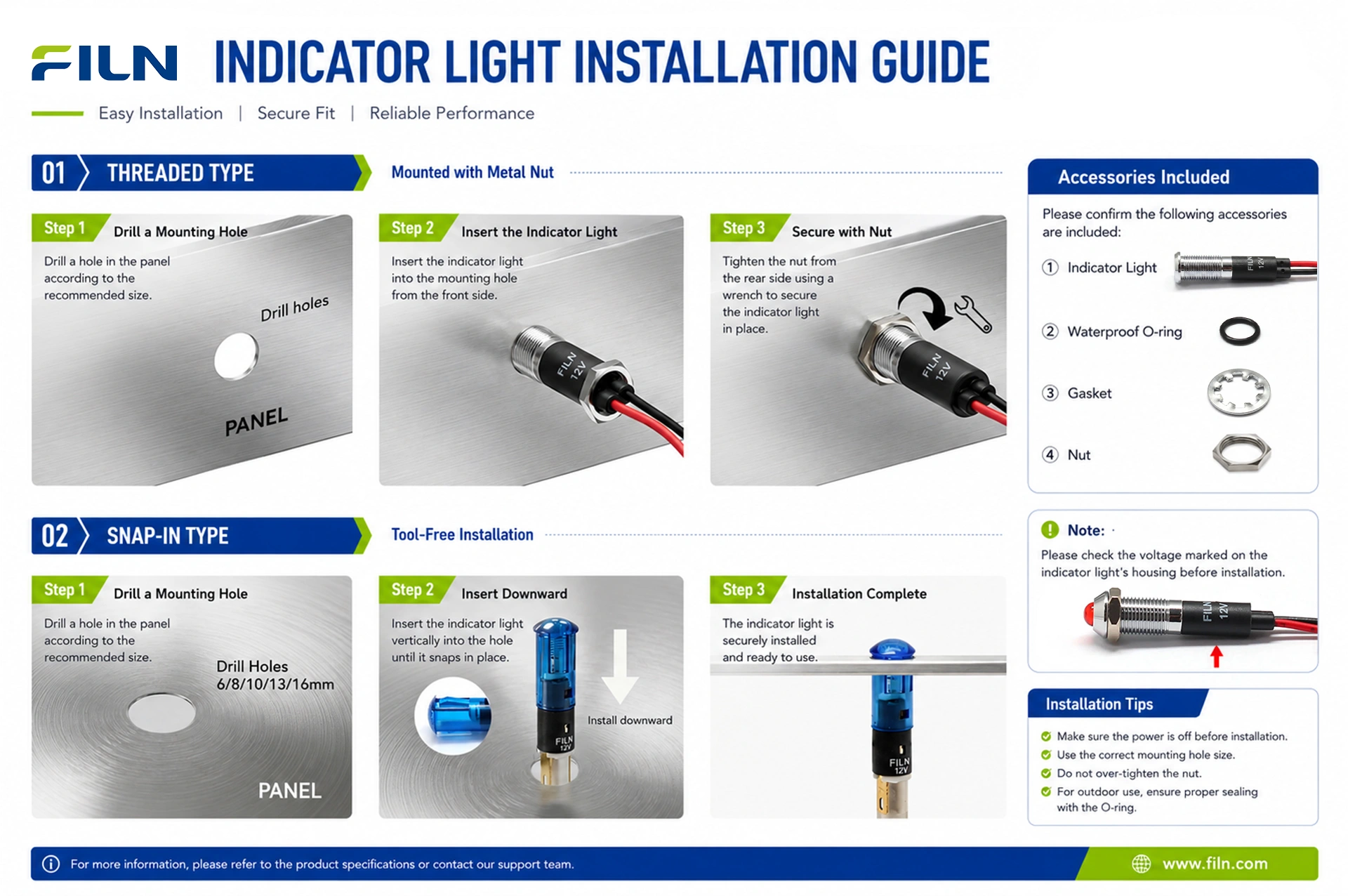
Train assemblers to hold the head still while the nut of the LED signal lamps is tightened so the lens does not rotate against a painted finish.
After paint or powder-coat touch-ups, re-check that the nut still starts freely on the thread of the LED signal lamps and that the finished thickness is still inside the approved window.
Keep spare LED signal lamps and spare plastic nuts in the line kit so a damaged lens or cross-threaded nut never blocks a shipping deadline.
Document the approved punch diameter and nut orientation next to the LED signal lamps callout on the mechanical drawing revision.
Wiring Guide
This FL1P-08NJ-2 configuration of LED signal lamps uses a 2PIN pin-terminal interface. Disconnect upstream power before any termination work on these LED signal lamps. Follow local electrical safety practice and your equipment directive requirements.
Polarized LED beads require correct DC polarity on the pins. Non-polar LED beads can be supplied so these LED signal lamps may be wired without DC polarity concern when that LED type is selected. State which LED type you need on the RFQ; do not assume a default beyond “available.”
Pin-type LED signal lamps stay compact behind the panel. Designers typically land the pins in a matching socket, a PCB footprint, or a short insulated jumper. Support the pins during handling so they are not bent, and confirm rear clearance for the nut plus the mating connection.
Wire-lead indicators, which are a different wiring style in the same factory range, route a flexible lead to a distant terminal. Those joints may use quick-connect terminals, soldered joints with insulation, or properly insulated twists where the harness standard allows. Avoid bare twists without insulation. This SKU does not include a factory wire lead, so do not invent a lead length or AWG for these LED signal lamps.
Comparison of 2PIN pin-type LED signal lamps versus wire-lead indicators — advantages, disadvantages, and typical use scope:
| Topic | 2PIN pin-type LED signal lamps (this SKU) | Wire-lead indicators (general, not this SKU) |
|---|---|---|
| Advantages | Compact behind the panel; no fixed lead length to dress; tidy in shallow enclosures; direct socket or PCB connection | Flexible routing to distant terminals; no PCB footprint required; convenient in harness-based cabinets |
| Disadvantages | Needs a planned socket, PCB hole, or short jumper; less routing flexibility; pins need protection during handling and nut tightening | Lead management and strain relief required; length must be specified or customized; more behind-panel bulk |
| Typical use scope | Instruments, compact modules, PCB-adjacent panels, dense 8mm equipment fronts | Distribution cabinets, appliances, vehicles, and general OEM panels that land on terminal blocks |
| This page | Specified interface for these LED signal lamps | Educational comparison only; ask FILN if you need a wire-lead family |
AC-rated or DC-rated builds of LED signal lamps must match the named voltage and, for AC, the frequency. Never apply an unconfirmed voltage “to see if it lights,” and never assume a low-voltage sample is interchangeable with a higher-voltage production lamp. Request the wiring diagram with your sample if pin legends are not yet fixed.
| Ask Wiring Confirmation | Request a Sample |
Protect the pins of LED signal lamps from side load while the plastic nut is tightened.
If a mating socket is required by the customer standard, approve that socket on the same drawing revision as the LED signal lamps.
High-pot planning for a cabinet should treat the pins of the LED signal lamps as part of the energized circuit under test.
For a connection sketch or 3D clearance check, request a 3D model / CAD file together with the wiring question.
Industry Knowledge Center
How LED signal lamps work: current through the LED junction produces light; the resistor and voltage rating keep that current inside the safe window. Panel designers choose hole size, head profile, color, and termination so the lamp is both readable and serviceable.
Why specification discipline matters: mismatched voltage is the most common field failure mode for panel lamps. A low-voltage lamp placed on a higher-voltage circuit will not behave as a dim lamp — it risks immediate damage. Equally, an oversized 8mm hole reduces clamp reliability for nut-mount LED signal lamps.
Selection checklist for plastic LED signal lamps: confirm hole (8mm here), voltage and AC/DC, color meaning, polarized versus non-polar LED, pin versus wire-lead termination, environmental IP needs, and certification paperwork for the destination market.
Common mistakes include ignoring phantom glow on high-impedance leakage paths; omitting series resistance on unofficial LED experiments; treating company capability certificates as automatic proof for every SKU of LED signal lamps; skipping a sample fit-check on actual panel thickness; and mixing pin-type and wire-lead callouts on the same item number.
Maintenance: clean the lens with a dry or lightly damp cloth; avoid solvents that attack PA66; re-check nut tightness after panel repaint or transport; and verify pin insulation or socket condition during scheduled electrical inspections.
Troubleshooting faint or “phantom” glow: LED signal lamps may glimmer when leakage current, induced voltage, or high-impedance controller outputs still feed the LED path. Remedies include proper load selection, bleed resistors where engineering-approved, shielded routing, and confirming the LED type. If glow persists at true zero energy, stop and re-test isolation.
Phantom-glow tickets should include measured residual voltage at the nodes of the LED signal lamps with the machine supposedly isolated.
Preventive maintenance routes can include a quick visual sweep of LED signal lamps for cracked lenses, loose nuts, or bent pins.
Engineering change orders that alter control voltage must cascade to the approved voltage list for LED signal lamps the same day.
A locked approved-vendor entry for these LED signal lamps prevents unofficial substitutions during shortage periods.
When a field issue needs factory input, email inquiry@cnylin.com.cn with photos, voltage, and the schematic fragment.
Buyer Decision Guide and RFQ Checklist
B2B procurement for LED signal lamps should treat the part as a controlled component: drawings, an approved voltage list, a color legend, and incoming inspection criteria belong in the quality packet. The guidance below is written for purchasing managers, engineers, OEM/ODM buyers, panel builders, and distributors in the US, Canada, Germany, UK, and Australia.
How to Choose
Start from the panel hole and available rear depth, then lock electrical ratings, then cosmetics (color and high-head profile), then paperwork (certificates, datasheet, 3D). For these LED signal lamps the hole is 8mm, the termination is 2PIN pins, and the clamp is a plastic nut. If the door already uses 6mm openings, compare the smaller family before you redesign the front.
Buying Considerations
Buying considerations for LED signal lamps include genuine voltage/AC-DC matching, color consistency across lots, polarized versus non-polar wiring rules, nut and pin robustness in your assembly process, certificate files for the destination market, sample approval, packaging, and whether OEM marking is required. Price, MOQ, and lead time are confirm-with-FILN items and are not published as fixed facts here.
Sizing Guide
Sizing reference across the plastic family (context for upgrades or alternates, not a claim that every size shares this SKU’s pins or nut):
| Mounting hole | Where it often appears | Selection note |
|---|---|---|
| 6mm | Dense instrument fronts, compact modules | See more 6mm plastic indicator lights if the cutout is already 6mm |
| 8mm (this page) | Common equipment panels and cabinets that need a slightly larger, easier-to-see high head | Specified hole for these LED signal lamps |
| 10mm / 12mm | General industrial doors needing a larger lens | Confirm family, termination, and nut or snap-in style with FILN |
| 16mm / 22mm | Standard industrial pilot-device cutouts and long-distance visibility | Often a different body style; do not assume pin-type hardware |
Certification Guide
Certification guide: this page lists CE, VDE, RoHS, and CCC as product marks stated for the offering, and ISO9001 as the company quality system. Always request the certificate PDF that matches the shipped LED signal lamps. Destination-market rules still govern what your equipment file must contain. Do not auto-add UL, TUV, or SGS as product claims for this SKU.
Material Selection Guide
Material selection — plastic housing versus metal housing, to support a plastic-versus-metal decision for LED signal lamps:
| Housing option | Advantages | Limits / environments |
|---|---|---|
| Plastic (PA66) LED signal lamps, this page | Light weight, electrical insulation, economical for OEM volume, adequate heat resistance for many indoor panels | Series-typical IP50; not a default wash-down or high-impact metal bezel |
| Nickel-plated brass (metal comparison) | Familiar industrial look, robust thread options on many metal families | Higher mass and typically higher cost; confirm IP and finish with that family |
| Stainless steel (metal comparison) | Corrosion-conscious fronts and certain hygienic or outdoor-adjacent designs | Cost and lead considerations; still confirm sealing separately |
| Zinc alloy (metal comparison) | Shaped bezels and decorative fronts on some metal lines | Finish wear and environment limits depend on the actual product family |
Application Matching Guide
Match LED signal lamps to the real environment: indoor cabinets and appliances often fit this plastic IP50-class starting point; wash-down, salt fog, or exterior duty may need a different family. Match voltage to the circuit, color to the legend, and termination to the harness or PCB strategy. Pin-type LED signal lamps fit shallow, socket-oriented designs; wire-lead lamps fit terminal-block cabinets.
Specification-to-Decision Framework
| Spec | What it means | Why it matters | When higher or lower | What to confirm before ordering |
|---|---|---|---|---|
| Mounting hole 8mm | Panel cutout diameter | Punching and retention | Smaller holes save space; larger holes improve distant visibility | Actual punched size and tolerance |
| Voltage 3–480V custom | Ordered electrical rating | Prevents immediate LED damage | Match the circuit; do not over- or under-specify | AC or DC, exact volts, frequency if AC |
| 2PIN pins | Rear termination style of these LED signal lamps | Defines socket/PCB/jumper design | Choose wire-lead if routing distance is long | Mating method and rear clearance with the nut |
| Plastic nut mount | Threaded clamp from the rear | Mechanical security | Snap-in families exist in other sizes/styles | Panel thickness and nut access |
| Color R/G/Y/B/W | Operator language | Safety and usability | Follow the legend, not warehouse leftover stock | Lot consistency and any special bin |
| IP50 (series typical) | Limited ingress protection | Environment fit | Higher IP only with a different confirmed product | Real exposure to dust, water, or wash-down |
| Cert marks stated | CE, VDE, RoHS, CCC plus company ISO9001 | Market access and QC files | Additional marks only if FILN confirms them for the build | Certificate set for the shipped configuration |
RFQ Checklist
RFQ checklist — send the following when requesting a quotation for LED signal lamps: product type; model FL1P-08NJ-2 or alternate; mounting hole (8mm); voltage; AC/DC; LED color; head type (circular high-head); material (plastic / PA66); waterproof or IP requirement; wiring method (2PIN pin terminals on this SKU); wire length (only if you are asking for a different, wire-lead family); connector or socket need; certification requirement; quantity; packaging; OEM; logo; custom marking; target market; application environment; and expected delivery date.
Providing these specifications helps FILN engineering and sales teams confirm product compatibility and quotation requirements more efficiently. MOQ, price, and lead time are configuration- and order-dependent and will be confirmed by FILN; they are not promised on this page.
| Request a Sample | Buy This Indicator |
| Request Datasheet PDF | Request 3D Model / CAD |
Procurement scorecards for a supplier of LED signal lamps usually weigh sample support, certificate completeness, and configuration control.
Blanket orders should still line-break each voltage and color of LED signal lamps so MRP stays accurate.
Ask FILN for packaging photos if kitted packs of LED signal lamps are required for downstream channel partners.
Customs files benefit when the commercial invoice description matches the wording used for these LED signal lamps on the packing list.
Close the loop with a single packet: catalog page, RFQ email, and 3D/CAD request.
FILN Manufacturing and Engineering Capabilities
FILN is the factory brand used by Yueqing Yulin Electronic Co., Ltd. for industrial LED signal lamps and related control components. The capabilities below are described in buyer-facing terms so procurement and engineering can see how a factory relationship works in practice.
Manufacturer and production. In-house production and assembly of LED signal lamps help keep configuration control on hole size, voltage, color, and termination. Buyers benefit from a single accountable source rather than an undocumented reseller chain.
R&D and engineering support. Engineering communication is available for drawings, pin orientation, nut clearance, and LED polarity questions. This shortens sample iterations when LED signal lamps must fit an existing panel.
OEM and ODM customization. Custom voltage within 3–480V, color selection, marking, and related options can be discussed for LED signal lamps. The buyer benefit is platform reuse across export markets without inventing a new supplier for every rating.
Testing, QC, and certification support. Factory inspection and laboratory checks support incoming quality plans. Certification support means FILN can help pursue or confirm the documents needed for a build; it does not mean every mark in the company portfolio automatically applies to these LED signal lamps.
Export, samples, small batch, and mass production. Technical communication in a factory-direct channel supports sample builds, pilot lots, and later volume of LED signal lamps for buyers in the US, Canada, Germany, UK, Australia, and other markets.
Learn more about the manufacturer at https://www.filn.com or email inquiry@cnylin.com.cn.
Clear written specifications remain the fastest way to get accurate engineering feedback on LED signal lamps.
Factory Direct Supply
Yueqing Yulin Electronic Co., Ltd., branding products as FILN, is based in Wenzhou, Zhejiang, and has operated since 2006 with integrated R&D, production, and sales. The organization reports product reach in 100+ countries, a facility on the order of 10,000 m², 20+ production lines, an independent testing laboratory, and an ISO9001 quality system. These are factory facts for supplier qualification of a source of LED signal lamps.
Product scope includes indicator lights, push-button switches, rocker switches, toggle switches, and related custom small electrical parts. When comparing suppliers of LED signal lamps, factory communication shortens the path from drawing change to sample.
Separation note: company or product-line capabilities may reference broader marks used across FILN categories. For this plastic page, the product marks explicitly stated for the offering are CE, VDE, RoHS, and CCC, while ISO9001 describes the company quality system. Always obtain the matching certificate file for the shipped configuration of LED signal lamps. Do not treat UL, TUV, or SGS as automatic claims for this SKU.

Company website: https://www.filn.com | Catalog product page: Buy this 8mm high-head indicator.
| Factory RFQ | Request Datasheet |
| Request 3D Model | Buy This Indicator |
Supplier qualification teams can review process flows that build LED signal lamps alongside related switch products in the same campus.
Factory escalation paths help when a lot of LED signal lamps needs rapid optical revalidation for a customer audit.
Long-term agreements should reference the controlled drawing of the LED signal lamps rather than only a marketing nickname.
Frequently Asked Questions
What are FILN LED signal lamps used for?
FILN LED signal lamps provide panel status indication on large electrical equipment, laboratory and test devices, distribution cabinets, new-energy systems, yachts, household appliances, and automotive modification projects that need a clear optical cue. Model FL1P-08NJ-2 is an 8mm circular high-head plastic lamp with 2PIN pin terminals and a plastic nut. Review factory capabilities at https://www.filn.com or open the product purchase page.
What mounting hole do these 8mm LED signal lamps require?
These LED signal lamps require an 8mm round cutout. Deburr the hole, insert the lamp from the front of the panel, and clamp it with the matching plastic nut from the rear. Confirm finished panel thickness with FILN if your door skin is unusual. For a smaller cutout in the same plastic family, see more 6mm plastic indicator lights.
How do I install 8mm high-head LED signal lamps with a plastic nut?
Cut a matching 8mm round hole, insert the lamp from the operator side of the panel, then spin the plastic nut upward toward the panel from the rear until the head sits square and secure. Complete wiring on the 2PIN pins only after mechanical retention is confirmed. A compact drawing is included on this page, and you may request a datasheet PDF for dimensions.
What wiring interface do these LED signal lamps use?
This configuration of LED signal lamps uses 2PIN plastic pin terminals, not a factory wire lead on this SKU. Pin-type exits stay compact behind the panel and suit sockets, PCB holes, or short jumpers. If your harness standard requires a pre-wired lead instead, ask FILN about a related wire-lead family and email a wiring confirmation request.
What voltage can be specified for these LED signal lamps?
Voltage for these LED signal lamps is customizable across 3–480V. There is no assumed single default rating on this page. State AC or DC, the exact volts, and 50/60 Hz when the circuit is AC. Email voltage customization to inquiry@cnylin.com.cn before releasing the purchase order.
Which LED colors are available on these LED signal lamps?
LED signal lamps on this page can be ordered in Red, Green, Yellow, Blue, or White (R/G/Y/B/W). Color meaning should follow your equipment legend, because conventions vary by OEM, industry, and country. Dual-color or tri-color builds are available only where applicable and must be confirmed with FILN; do not assume this SKU includes them.
Can I wire these LED signal lamps without observing LED polarity?
Yes, when a non-polar LED bead is selected, these LED signal lamps can be wired without observing DC polarity. Polarized (positive/negative) LED beads remain available when your standard requires them. Specify the LED type on the RFQ and confirm the option with FILN.
What certifications are stated for these LED signal lamps?
This page states CE, VDE, RoHS, and CCC as product marks for the offering, with ISO9001 describing the company quality system. Request the certificate files that match the exact voltage and color of the shipped LED signal lamps. Company information is available at https://www.filn.com.
How do plastic LED signal lamps compare with metal indicators?
Plastic LED signal lamps such as this 8mm high-head model are typically lighter and more cost-efficient than comparable metal-bodied lamps for indoor OEM panels. Metal housings offer a different mechanical presence and may suit harsher fronts. Series-typical ingress protection here is IP50, not an automatic wet-location rating. Compare families in the panel indicator lights category.
When should I choose pin-type LED signal lamps instead of wire-lead lamps?
Choose pin-type LED signal lamps when behind-panel space is tight, when a socket or PCB connection is planned, or when you want to avoid managing a fixed lead length. Choose wire-lead lamps when the connection point is farther away or the assembly is harness-based. This SKU is the 2PIN pin-type version; review the comparison table in the wiring section before you freeze the drawing.
Why do LED signal lamps sometimes show a faint glow when the machine is off?
Phantom or faint glow on LED signal lamps often comes from leakage current, induced voltage, or high-impedance outputs that still feed the LED path. Verify true isolation, review bleed-resistor strategies with your electrical engineer, and confirm whether a polarized or non-polar LED was supplied. Contact FILN engineering via inquiry@cnylin.com.cn with schematic notes.
What is included in the package for these LED signal lamps?
The described pack is 1× plastic indicator light, which includes the circular high-head lamp body and the matching plastic nut used for threaded mounting. Additional sockets, harnesses, or spare nuts are not assumed in the standard pack. If kitted accessories are required, list them on the RFQ to inquiry@cnylin.com.cn.
Is a product drawing available for these 8mm LED signal lamps?
Yes. A compact dimensional drawing for these LED signal lamps is published on this page to help designers check head profile, pin orientation, and nut stack at 8mm. For a datasheet PDF or a 3D/CAD model, request 3D model / CAD from inquiry@cnylin.com.cn or request the datasheet.
How do I request a sample, datasheet, or 3D model for these LED signal lamps?
Send a structured RFQ with mounting hole (8mm), voltage and AC/DC, LED color, polarized or non-polar bead, quantity intent, and destination market. Use Request a Sample, Request Datasheet, or Request 3D Model. Purchasing links remain on the product catalog page.
Do these LED signal lamps include dual-color or tri-color LEDs?
Dual-color or tri-color LED signal lamps may be available where applicable, but this page does not claim that model FL1P-08NJ-2 includes those emitters as standard. Confirm any multi-color requirement with FILN before you add it to a controlled drawing. Standard color choices described here are Red, Green, Yellow, Blue, and White.
What environmental limits apply to these plastic LED signal lamps?
Series-typical figures used across FILN plastic LED signal lamps include operating and storage temperature of −15°C to +80°C, operating humidity ≤85% at +40°C, and IP50 ingress protection. Those numbers are configuration-dependent and must be confirmed for the exact build. This page does not upgrade the rating to IP65 or IP67.
How do 8mm LED signal lamps differ from the 6mm plastic family?
These 8mm LED signal lamps use a larger cutout, a circular high-head profile, 2PIN pins, and a plastic nut. Many 6mm plastic lamps in the same factory range use a smaller hole and may use a different retention or wiring style. If your panel already has 6mm openings, open more 6mm plastic indicator lights before you redesign the cutout.
What does the installed appearance of these LED signal lamps look like?
Installed LED signal lamps present as a circular high-head lamp on the front of the panel, with a bright and easy-to-see lens and 2PIN pins behind the sheet. The plastic nut is tightened from the rear and should not be visible from the operator side when the head seats correctly. Keep the head square to the surface during tightening.
What should a purchasing RFQ for these LED signal lamps include?
A useful RFQ for LED signal lamps lists product type, model FL1P-08NJ-2, 8mm hole, voltage, AC/DC, color, high-head style, PA66 plastic body, IP need, 2PIN pin wiring, certification need, quantity, packaging, OEM marking, target market, and environment. Providing these specifications helps FILN engineering and sales teams confirm product compatibility and quotation requirements more efficiently. Email the checklist to inquiry@cnylin.com.cn.
Where can procurement teams buy or specify these factory LED signal lamps?
Procurement can review and purchase via the catalog at https://www.cnfiln.com/products/8mm-high-head-plastic-lights-indicator, read manufacturer information at https://www.filn.com, or email inquiry@cnylin.com.cn for a factory quotation. MOQ, price, and lead time are confirm-with-FILN items and are not stated as fixed figures on this page.