


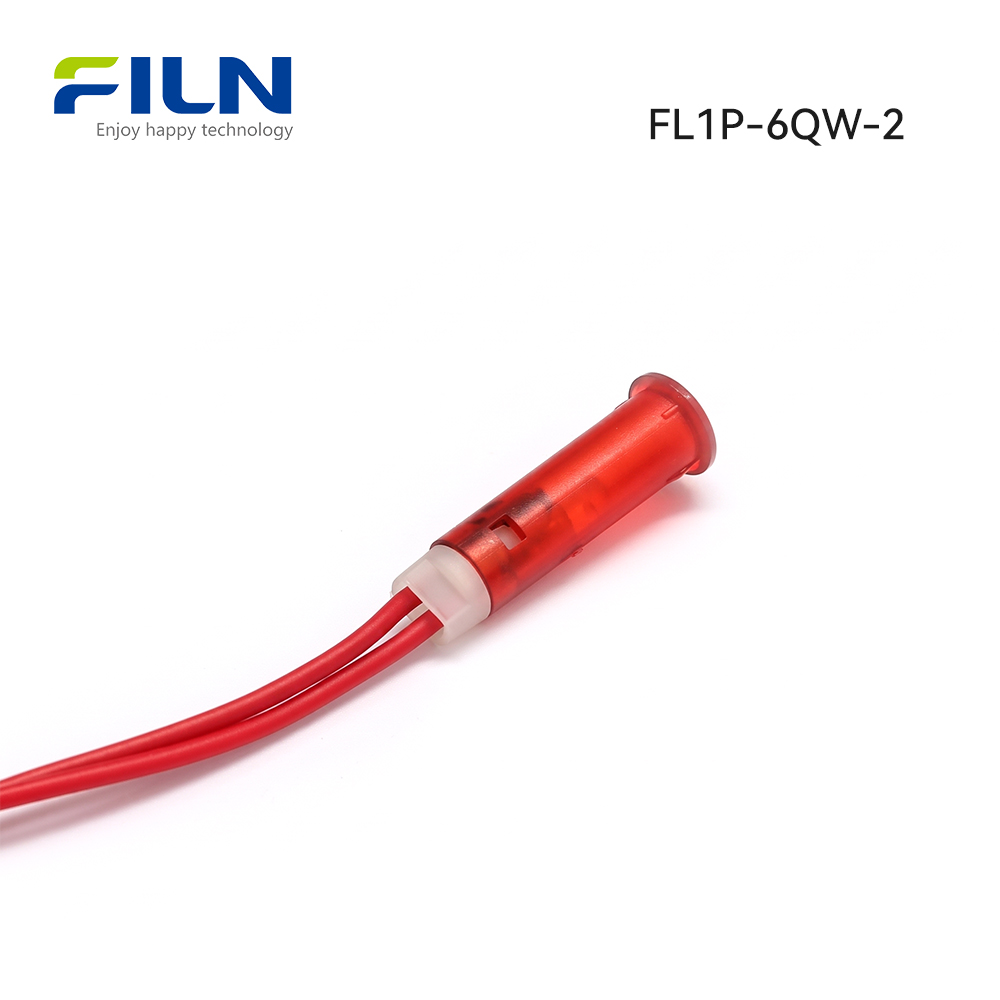
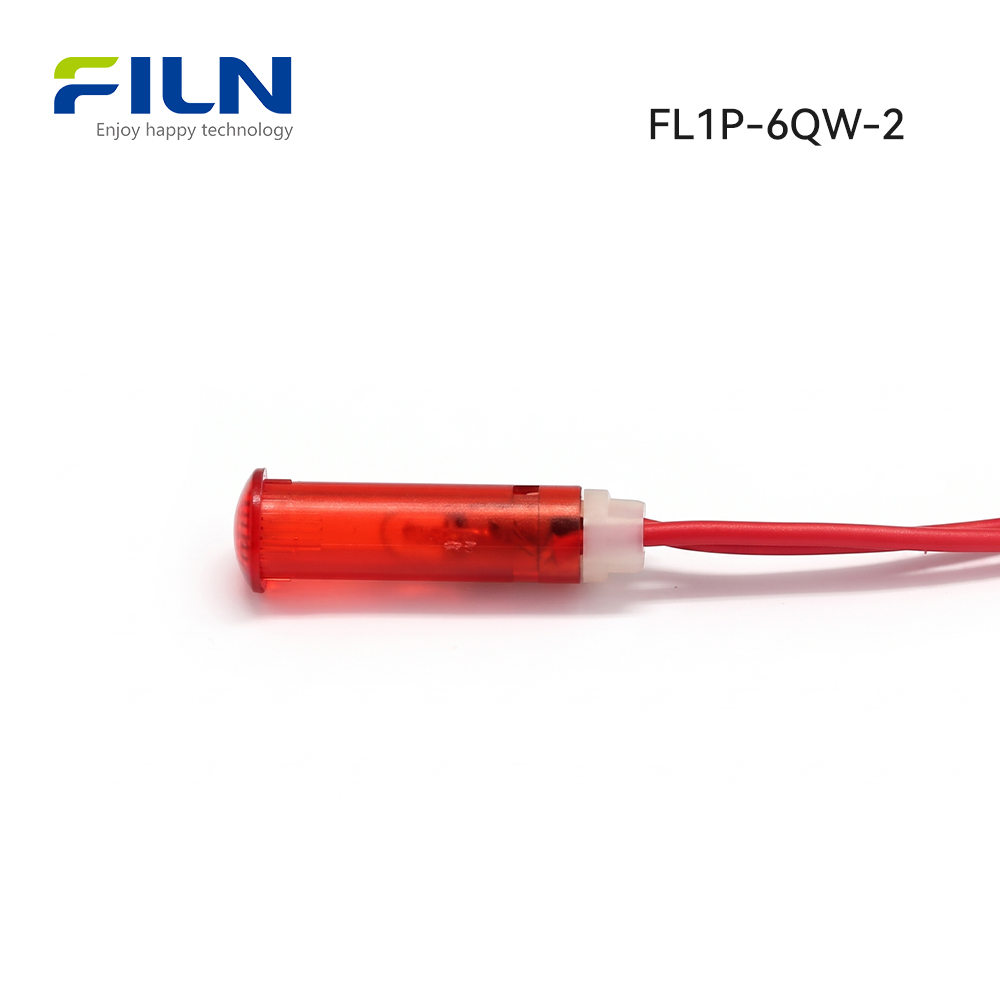
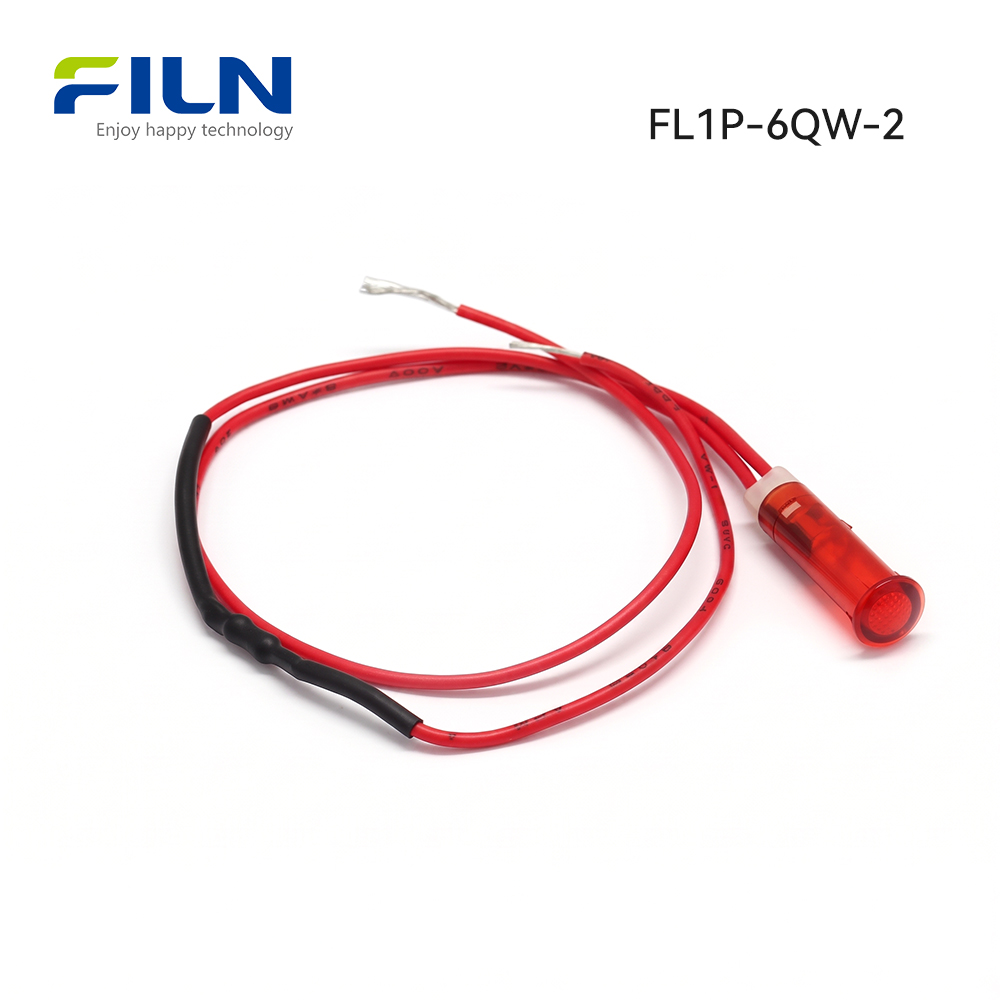


6mm Panel Indicator Light 220V with 2-Pin Wire Lead | FILN
Product Specifications
• Model: FL1P-06QW-2
• Color: Five LED colors available
• Shape: Round head
• Material: PA66 housing
• Finish Type: Plastic finish
• Light Source Type: Polarized or non-polar LED beads
• Rated Voltage: Custom voltages across a 3–480V range (optimized for 220V)
• Rated Current: Customizable
• Mounting Type: Snap-in installation
• Terminal / Wiring: 2PIN wire-lead exit
• Protection Rating: CE, VDE, RoHS, ISO9001 Certified
• Product Size: 6 mm (0.24 inch)
• Other Key Specifications: Compact panel indicator light manufactured by FILN
• Download PDF: 6MM plastic indicator light -FL1P-6WQ-2
• Email: inquiry@cnylin.com.cn
About this item
• Main Advantage: The FL1P-6QW-2 provides a clear AC status signal on crowded front panels without requiring a threaded nut stack.
• Durability & Reliability: Features a robust PA66 housing and certified compliance to international quality and safety standards.
• Installation & Compatibility: Engineered for easy snap-in mounting utilizing a 6 mm (0.24 inch) hole and a 2PIN wire-lead exit configuration.
• Applications: Perfectly designed for OEM control panels, electrical distribution cabinets, and equipment builders needing reliable status indication.
• OEM & ODM: Factory support includes custom voltage configurations across 3–480V, selectable LED colors, and specialized wire length options.

Product Summary
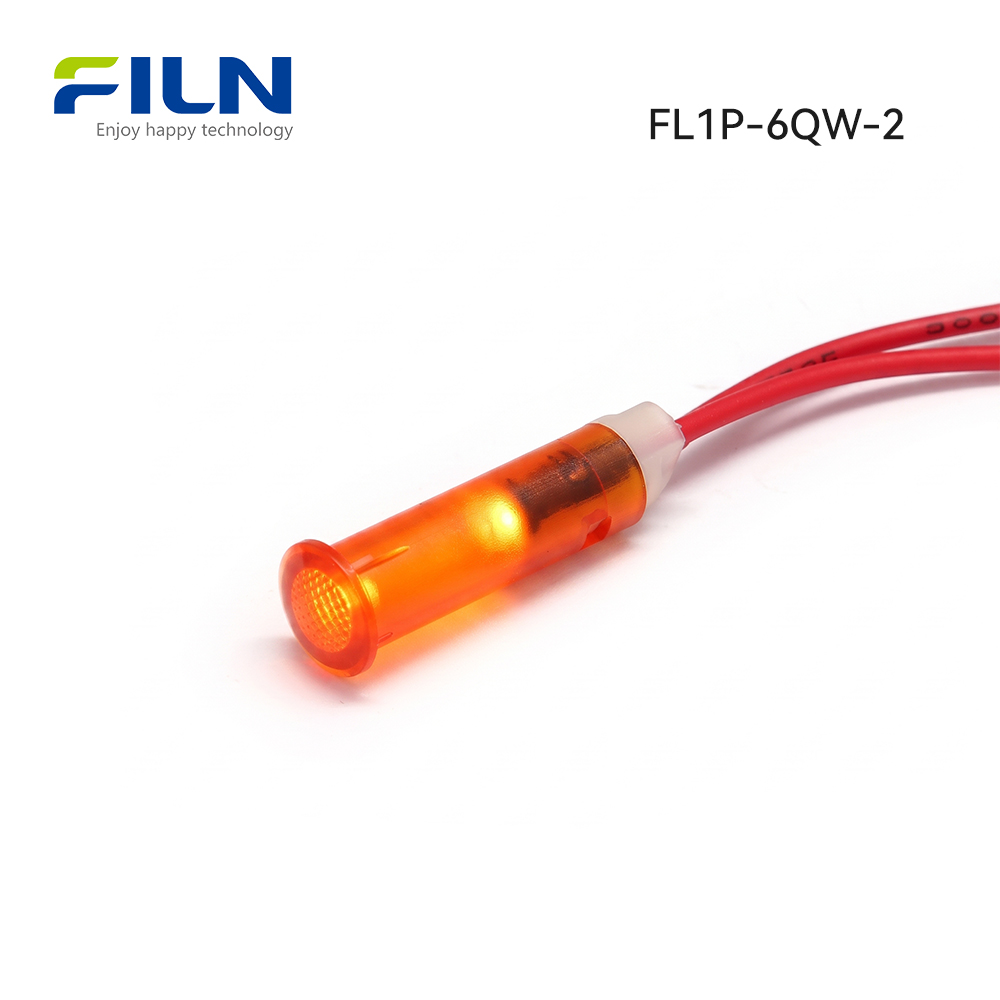
FILN manufactures a compact panel indicator light 220v configuration for OEM control panels, distribution cabinets, and equipment builders that need a clear AC status signal on a crowded front. This 6mm snap-in plastic pilot light indicator uses a round head, PA66 housing, and a 2PIN wire-lead exit so panel builders can place a bright lamp without a threaded nut stack.
While many buyers specify a 220V AC panel indicator for mains-referenced circuits, the factory still supports custom voltages across a 3–480V range—always confirm AC or DC and the exact rating on the RFQ. Five LED colors and polarized or non-polar LED beads are available depending on the ordered lamp. View this 6mm panel indicator on the FILN sales catalog or email an RFQ to lock voltage, color, and wire length for your drawing.
Key Takeaways
- This page covers a FILN panel indicator light 220v focus build in a 6mm round plastic snap-in format with 2PIN wire leads (model FL1P-06QW-2).
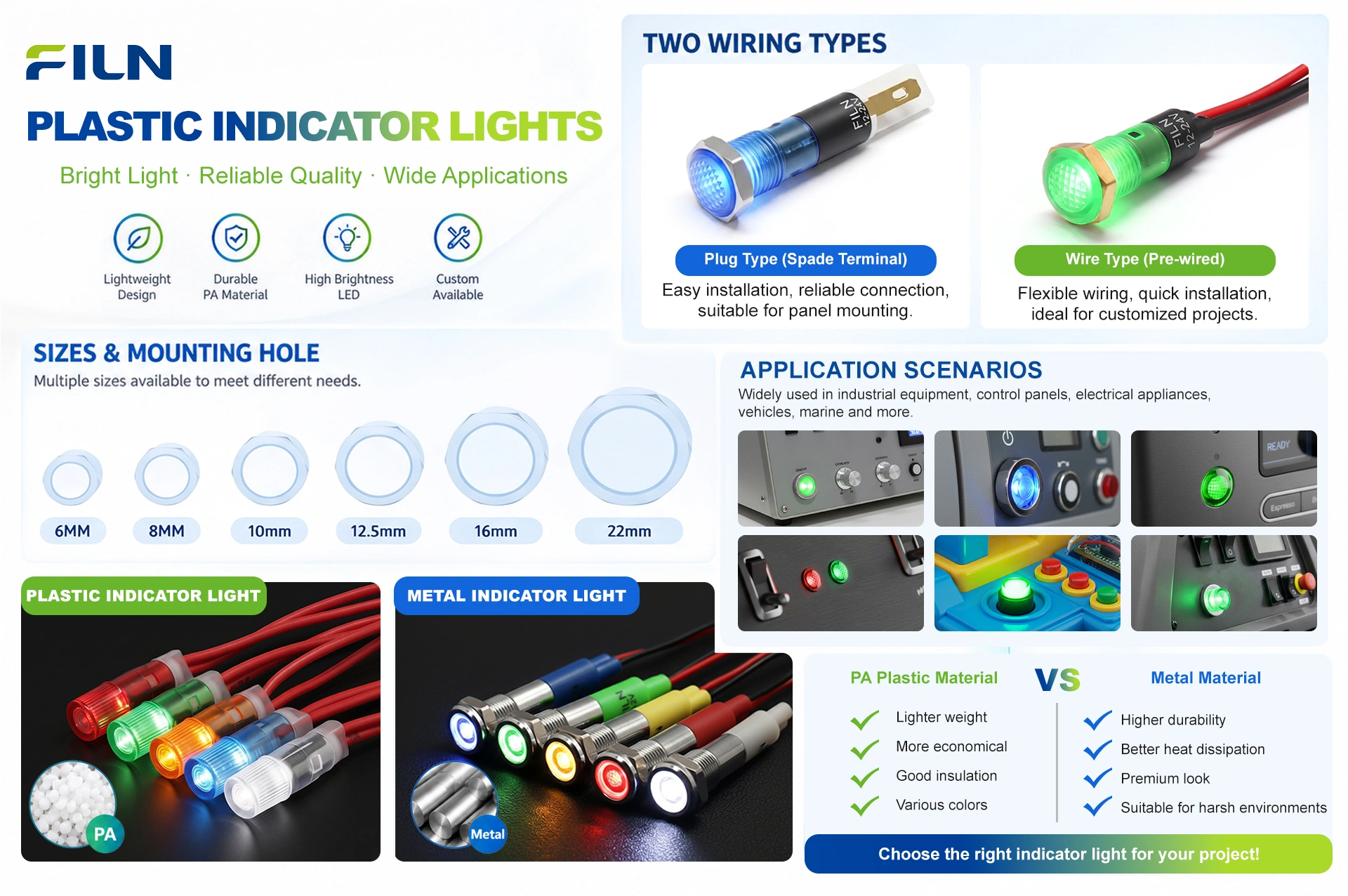
- A plastic pilot light indicator in this size is lighter and typically more cost-efficient than a comparable metal-bodied lamp for indoor AC control panels.
- Mounting hole diameter is 6mm; installation is buckle / snap-in from the front of the panel.
- Wire-lead length on this configuration is 15cm with a 2PIN exit for straightforward harness routing behind 220V-class panels.
- Many OEM drawings call out a 220V AC panel indicator; the factory still offers 3–480V customization—confirm AC or DC and exact rating before ordering.
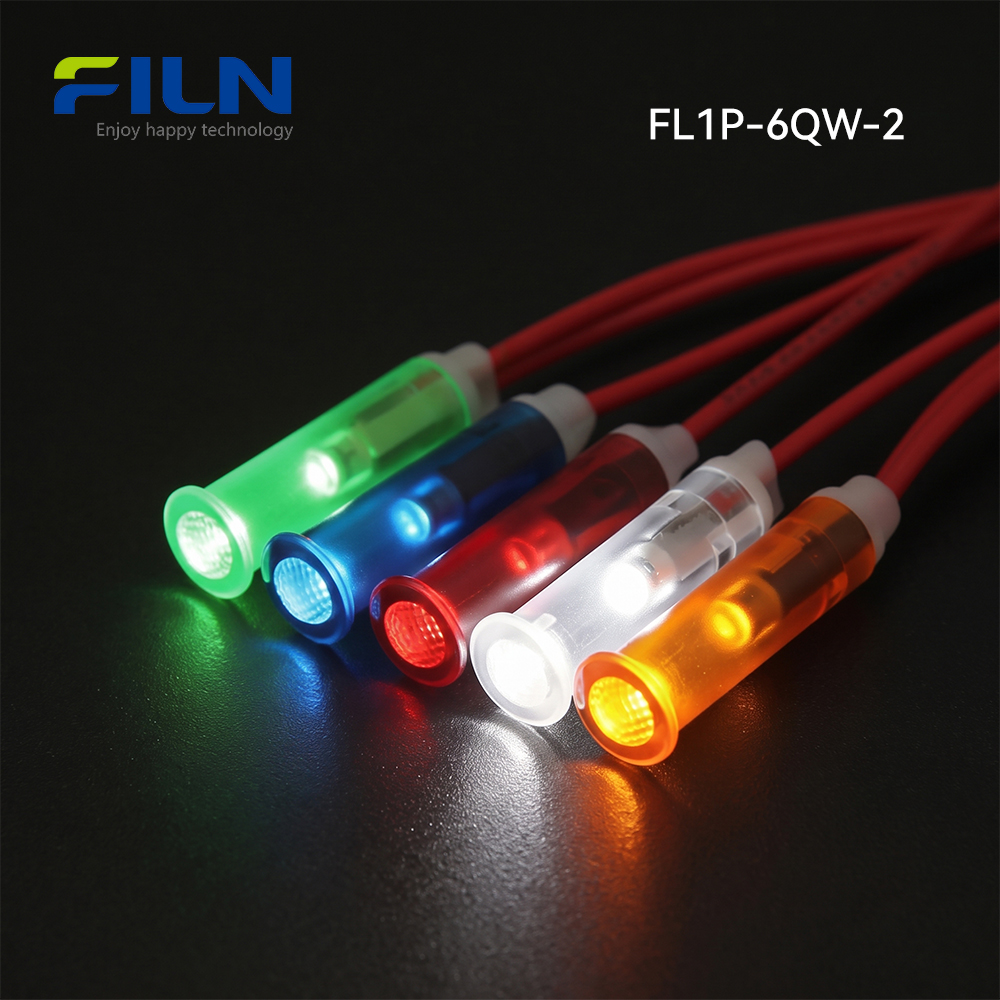
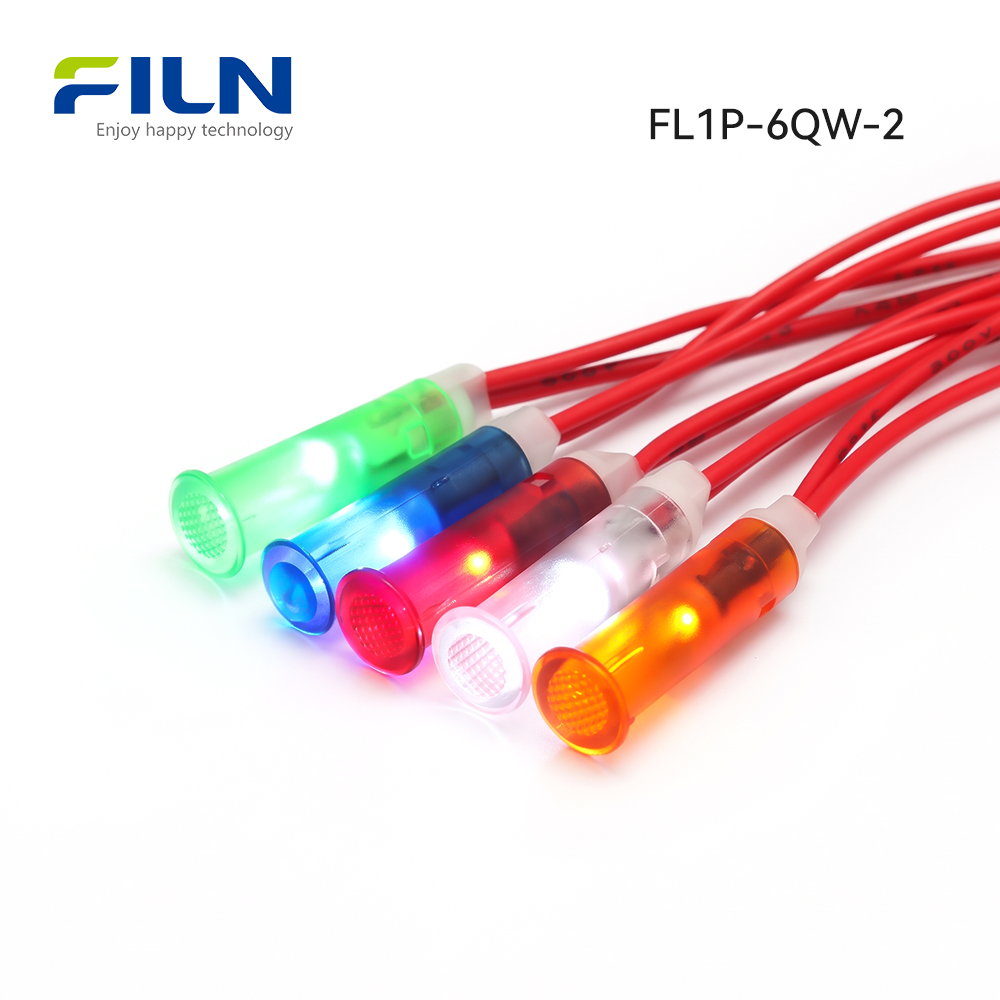
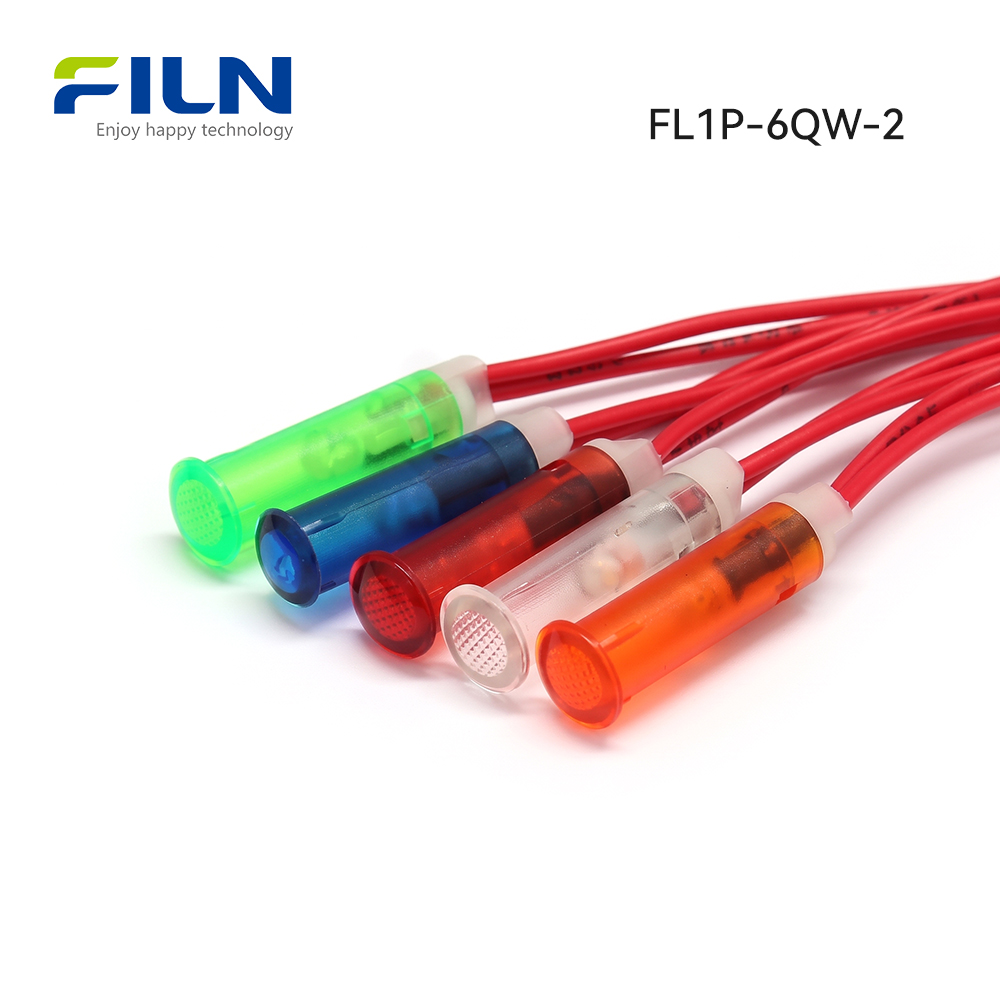
- LED colors available: Red, Green, Yellow, Blue, and White (R/G/Y/B/W).
- Product-page certification marks stated for this offering: CE, VDE, RoHS, ISO9001, and CCC — request certificates for the exact build.
- Package contents: 1× plastic pilot light indicator per unit pack as described here.
- Polarized LED beads and non-polar LED beads can both be supplied; non-polar builds allow polarity-free DC wiring when that LED type is selected.
- Series-typical electrical limits (≤20mA, approx. 0.2W, IP50, −15°C to +80°C) are configuration-dependent and must match the ordered voltage/color.
- FILN is the factory brand of Yueqing Yulin Electronic Co., Ltd., supporting OEM/ODM, samples, datasheets, and 3D/CAD requests for B2B buyers in the US, Canada, Germany, UK, and Australia.
- Use the RFQ checklist below when you need a quotation, sample, datasheet PDF, or mechanical model for a 220V panel design-in.
What Is a Plastic Indicator Light?
A plastic indicator light is a panel-mounted optical status device that uses an LED inside an insulating polymer housing to show machine state. In industrial catalogs it is also called a plastic LED pilot light or plastic panel indicator. FILN produces this category as factory-made lamps for buyers searching a panel indicator light 220v solution on AC control fronts.
The function of a pilot light indicator is simple and critical: convert an electrical presence or logic signal into a visible color cue for operators and service technicians. Engineers place the lamp where power-on, run, fault, or mode status must be read at a glance without opening the enclosure—especially on 220V AC panels common in many export markets.
Structure typically includes a lens or head, a PA66 plastic shell and base, an LED emitter, a current-limiting resistor, and a wiring interface. On this 6mm pilot light indicator, the interface is a 2PIN wire lead rather than a screw terminal block, which shortens assembly time on dense panels.
Purpose and industrial value center on reliable human-machine feedback. A correctly specified pilot light indicator reduces mis-operation, speeds troubleshooting, and standardizes status language across a product family. Plastic housings cut weight and material cost versus metal barrels when the environment does not require a metal bezel.
Operating principle: rated voltage is applied across the LED path; the resistor sets current; photons exit through the round head. For a 220V AC panel indicator light, the build is designed for the named mains-class rating at 50/60Hz where applicable. DC builds may use polarized or non-polar LED beads according to the ordered option.
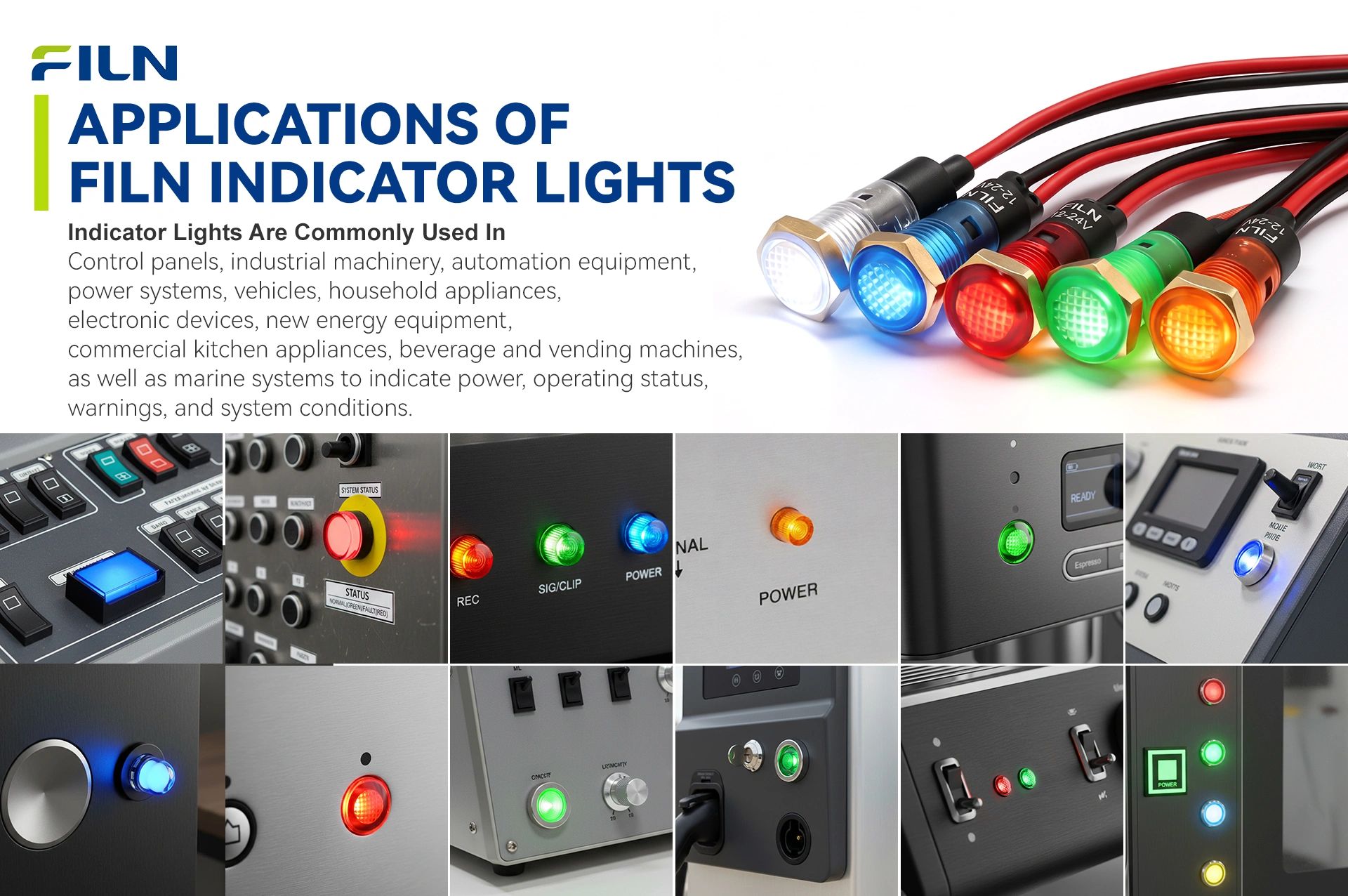
Typical applications for a plastic pilot light indicator include industrial automation panels, light machinery, household appliances, automotive interior and modification projects, laboratory instruments, medical-adjacent benchtop devices (where specified by the OEM), commercial self-service equipment, distribution cabinets, new-energy skids, and yacht electrical panels that need a compact status lamp.
Category context: buyers usually compare metal indicator lights with plastic indicator lights. Metal bodies suit harsher fronts and certain aesthetic standards; plastic bodies suit weight-sensitive, cost-sensitive, and high-volume OEM panels. FILN plastic sizes commonly discussed in the family include 6mm, 8mm, 10mm, 12mm, 16mm, and 22mm. Colors are Red, Green, Yellow, Blue, and White. Plastic wiring methods include pin-type, pre-wired wire-lead, and screw-terminal versions. This page focuses on the 6mm wire-lead snap-in pilot light indicator with a strong 220V panel-use intent.
| Request a Sample | Buy This 6mm Indicator |
| Request Datasheet PDF | Request 3D Model / CAD |
Browse all plastic / panel indicator lights
Open Full Category →
Opens in a new window for related sizes and wiring styles.
Open Full Category →
Opens in a new window for related sizes and wiring styles.
More 6mm plastic indicator lights →
Buyers searching for a factory pilot light indicator typically compare hole size, termination style, voltage class (including 220V AC), and certificate availability before requesting samples.
Clear first-party specifications help a pilot light indicator page serve both design engineers and purchasing officers reading the same URL.
FILN writes this pilot light indicator content for specification and RFQ use, not for vague promotional slogans.
Product Overview
FL1P-06QW-2 is a factory-supplied 6mm round plastic pilot light indicator with 2PIN wire leads. It belongs to FILN’s family of panel-mount plastic lamps intended for B2B panel builders, OEMs, distributors, and importers who need a repeatable snap-in status lamp—often ordered as a panel indicator light 220v AC configuration for control cabinets.
Mechanically, the pilot light indicator seats in a 6mm round cutout; side plastic buckles retain the body against the panel thickness range approved for this snap-in design. Electrically, an internal LED and resistor form the luminous path, while the 15cm leads extend to the harness or terminal zone behind the panel.
On the finished panel the pilot light indicator appears as a circular illuminated head with a bright, easy-to-read beam suitable for status indication on 220V AC equipment fronts. Compared with metal barrels, the plastic construction is lighter and generally more economical for high-volume equipment lines that still require a durable PA66 shell.
FILN positions this pilot light indicator as a manufacturer-direct item: voltage customization (including dedicated 220V AC builds), color selection, polarized or non-polar LED options, sample evaluation, datasheet support, and CAD/3D requests are handled as standard B2B workflows rather than retail-only catalog browsing.
Factory documentation for this pilot light indicator should travel with the OEM electrical BOM so purchasing, assembly, and service share one approved configuration—especially when multiple voltages coexist beside a 220V AC lamp line.
When multiple voltages coexist in a plant standard, label each pilot light indicator bag and reel clearly to prevent line-side mix-ups between 24V DC and 220V AC bins.
Distributors serving panel shops often keep a mixed-color sample board of the same pilot light indicator hole size for customer demos of 220V panel layouts.
A well-documented pilot light indicator package reduces field returns when installers move between 24V and 220V AC lines on the same shop floor.
Keep approved samples of each pilot light indicator voltage beside the production BOM so line leads can verify the resistor marking before release.
Quick Specifications
The following quick specification table consolidates the FL1P-06QW-2 data pack for buyers comparing a panel indicator light 220v option against other voltages in the same mechanical family. Every row is intended for RFQ copy-paste. Where a field is configuration-dependent, confirm the exact build with FILN before releasing production orders.
| Parameter | Value |
|---|---|
| Product name | 6mm round plastic pilot light indicator (panel indicator light 220V focus) |
| Model | FL1P-06QW-2 |
| Brand / manufacturer | FILN (Yueqing Yulin Electronic Co., Ltd.) |
| Mounting hole size | 6mm |
| Head type | Round plastic indicator head |
| Mounting method | Snap-in / buckle installation |
| Wiring type | 2PIN with wire lead |
| Wire length | 15cm |
| Voltage range | 3–480V customizable; many OEM RFQs specify 220V AC — confirm AC/DC and exact rating |
| LED colors | R / G / Y / B / W (Red, Green, Yellow, Blue, White) |
| LED polarity options | Polarized LED beads or non-polar LED beads (configuration-dependent) |
| Package contents | 1× plastic indicator light |
| Housing material (series typical) | Nylon PA66 shell / base / lens |
| Ingress protection (series typical) | IP50 — confirm if a different rating is required |
| Certifications stated for this page | CE, VDE, RoHS, ISO9001, CCC (request certificates for the ordered configuration) |
| Primary applications | Large electrical equipment, laboratory equipment, distribution cabinets, new energy, yachts, household appliances, automotive modification, and other 220V-class signal-indication panels |
Procurement note: a pilot light indicator quotation should always restate hole size, voltage (for example 220V AC), color, wire length, polarity type, marking needs, and target market so the factory can match tooling and LED bins correctly.
Copy the quick-spec rows into your RFQ email so FILN can mirror every field on the pilot light indicator quotation without ambiguity.
If a drawing still shows a threaded metal lamp, note the conversion to this snap-in pilot light indicator explicitly for the fabricator.
Export buyers reviewing a pilot light indicator datasheet should check that the named 220V AC build matches the resistor code printed on the sample bag.
Performance Parameters
Electrical and protection values below combine the user data pack with FILN plastic-indicator series-typical figures. Treat series-typical rows as configuration-dependent: the ordered voltage and LED color of each pilot light indicator must be confirmed on the quotation and datasheet—especially for a 220V AC panel indicator light.
| Performance item | Rating / note |
|---|---|
| Rated operating voltage (this product) | 3–480V customizable; 220V AC builds typically 50/60Hz where applicable — confirm exact rating |
| Rated operating current (series typical) | ≤ 20mA |
| Rated power (series typical) | Approx. 0.2W |
| Insulation resistance (series typical) | ≥ 100MΩ at 500V DC between leads and housing |
| Dielectric strength (series typical) | 1500V AC — no breakdown or flashover under stated test |
| Operating life (series typical) | 60,000 hours |
| Ingress protection (series typical) | IP50 |
| Product certifications (as stated for this page) | CE, VDE, RoHS, ISO9001, CCC |
For export documentation, ask FILN to attach the certificate set that corresponds to the shipped pilot light indicator lot. Company-wide capability marks are not a substitute for the file tied to your exact voltage and color configuration.
| Request Quotation / Spec Confirmation |
Incoming inspection can sample illuminate each pilot light indicator at the named voltage—such as 220V AC—and record color against the PO line.
Insulation and dielectric series-typical values help electrical safety reviewers compare this pilot light indicator with alternate lamp technologies on mains-referenced panels.
Record lot numbers for every pilot light indicator voltage release so a field complaint can be traced to the exact 220V AC build.
Component Materials
Material selection for this plastic pilot light indicator prioritizes insulation, heat resistance, flame retardancy, low mass, and cost efficiency—important traits when the lamp sits on a 220V AC panel skin. The table lists series-typical bill-of-materials items used across FILN plastic panel indicators, with wire length updated to the 15cm lead on this model.
| Component | Material / type | Why it matters |
|---|---|---|
| Shell / base / lens | Nylon PA66 | Electrical insulation, heat resistance, light weight, economical for OEM volume |
| Light source | 5mm LED (polarized or non-polar per order) | Defines color, brightness, and wiring polarity rules |
| Current limiting | Carbon film resistor | Sets safe LED current for the rated voltage build, including 220V AC configurations |
| Wire lead | PVC wire, 15cm, 2PIN | Routes the signal to the harness; length specified for this model |
| Nut / O-ring / lock washer | Not applicable on this snap-in wire-lead design | Retention is by plastic buckles in the panel cutout |
If a drawing calls for a different lead length or connector termination on the pilot light indicator, state that requirement in the RFQ. Custom wire prep is an OEM conversation item rather than an assumption from this page.
PA66 on this pilot light indicator keeps the illuminated head electrically insulated from the panel skin in normal indoor builds, including many 220V AC cabinet doors.
Resistor selection inside the pilot light indicator is paired to the ordered voltage; do not swap heads across voltage bins in the stockroom.
Warehouse labels for each pilot light indicator SKU should spell out 220V AC versus other ratings in large type.
Environmental Performance
Environmental figures are series-typical for FILN plastic indicator lines and must be confirmed for the exact FL1P-06QW-2 voltage/color build. They describe the climate window in which a pilot light indicator is expected to remain functionally stable under stated laboratory tests.
| Item | Series-typical value |
|---|---|
| Operating & storage temperature (series typical) | −15°C to +80°C |
| Operating relative humidity (series typical) | ≤85% at +40°C |
| High-temperature test (series typical) | 96h at 80±2°C |
| Low-temperature test (series typical) | 96h at −15±2°C |
| Constant temperature/humidity (series typical) | 96h at 40±2°C, 90%–95% RH |
| Temperature cycling (series typical) | −15°C 30min / 80°C 30min, 5 cycles |
Outdoor wash-down, marine salt fog, or higher ingress requirements may need a different pilot light indicator family or sealing strategy. This page does not claim IP65/IP67 for the FL1P-06QW-2 plastic snap-in body.
Climate chamber data for the series informs storage rules for spare pilot light indicator inventory in non-conditioned warehouses.
If the end equipment sees wash-down, ask FILN for a different sealed family rather than assuming this pilot light indicator is watertight.
Indoor distribution rooms remain the typical home for this pilot light indicator when IP50 series-typical protection is accepted.
LED Specification
LED absolute maximum ratings below are series-typical references used when FILN engineers bin emitters for plastic panel lamps, including a panel indicator light 220v resistor-matched build. Electro-optical outputs (forward voltage, intensity, dominant wavelength) vary by color and batch; request the datasheet for the ordered pilot light indicator rather than copying generic web values into a controlled drawing.
| Absolute maximum / assembly note | Series-typical value |
|---|---|
| Peak forward current IFP (series typical) | 20mA |
| Reverse voltage VR (series typical) | 5V |
| Power dissipation PD (series typical) | 60mW |
| Operating current in lamp assembly (series typical) | ≤20mA as assembled with resistor for rated voltage |
Color options for this pilot light indicator remain Red, Green, Yellow, Blue, and White. Exact luminous intensity, viewing angle, and wavelength windows are configuration-dependent. FILN can provide measured or datasheet values with your sample or RFQ package.
Not specified as numeric electro-optical tables in the available product data: per-color VF, IR, Iv, and dominant wavelength. Confirm with FILN before locking optical acceptance criteria.
| Request LED Optical Datasheet |
Optical acceptance criteria for a production pilot light indicator should cite the datasheet FILN returns with the approved sample.
Color bin continuity matters when a product family uses the same pilot light indicator across several years of production on 220V AC equipment lines.
Ask FILN to note the approved LED bin on the pilot light indicator sample tag when optical matching is critical.
Standard Test Conditions
Unless a customer standard is agreed in writing, FILN references the following atmosphere for routine checks on a plastic pilot light indicator. Measurement tolerances and photometric calibration practices should follow the datasheet notes supplied with the order.
| Condition | Series-typical reference |
|---|---|
| Ambient temperature | 5°C to 35°C |
| Relative humidity | 45% to 85% |
| Air pressure | 86 to 106 kPa |
| Photometric note | Use calibrated instrumentation consistent with the FILN datasheet; CIE-related setup details are configuration/document dependent |
If your quality plan needs PPAP-style optical sampling on every pilot light indicator shipment, state the AQL and meter model in the RFQ so the factory laboratory can align fixtures.
Align photometric bench temperature with the stated atmosphere when correlating pilot light indicator samples between labs.
Share the meter model with FILN so the pilot light indicator optical report uses a comparable geometry.
Applications by Industry
A panel indicator light 220v configuration in the 6mm plastic snap-in format appears wherever a compact pilot light indicator must show power or mode status on a crowded AC control panel. The wire-lead style suits harnessed assemblies behind sheet-metal or plastic fronts.
Large electrical equipment and distribution cabinets use this pilot light indicator for feeder status, interlock indication, and compartment power presence on 220V AC circuits. Laboratory equipment benefits from the small footprint when front panels already carry dense HMI components.
New-energy systems and yacht electrical panels often need a light-weight pilot light indicator that still remains readable in technical spaces. Household appliances and automotive modification projects use the same plastic family when a metal bezel is unnecessary and cost or mass targets are tight.
Qualitatively, a plastic pilot light indicator trades some mechanical prestige and certain harsh-front capabilities of metal lamps for easier mass deployment. Keep IP50 series-typical protection in mind: indoor, relatively clean panel interiors are the normal fit unless FILN confirms a different sealed product.
Need related panel indicators? Open the full category:
All panel indicator lights
|
More 6mm plastic indicator lights
All panel indicator lights
|
More 6mm plastic indicator lights
Marine and yacht builders still verify corrosion and moisture expectations separately from the basic pilot light indicator optical function.
Appliance OEMs favor this pilot light indicator format when front-panel branding needs a clean round lamp without a metal bezel ring on 220V AC products.
Automotive modification panels use the pilot light indicator for accessory circuits where a compact status cue is enough.
New-energy skids place the pilot light indicator on local disconnect enclosures so technicians see energization state before opening doors.
Public equipment builders also use this pilot light indicator where a small round lamp must survive frequent operator glances without a metal bezel.
LED Indicator Color Meanings and Application Guide
Color language on a pilot light indicator is conventional, not universal. OEMs, industries, and countries assign meanings differently. Use the guide below as a starting point when selecting a panel indicator light 220v color set, then lock meanings in your HMI specification.
| Color | Common meaning | Typical panel use | Selection note |
|---|---|---|---|
| Red | Fault, emergency stop chain active, alarm, danger presence | Stop / alarm lamps, over-temp alerts | Confirm if blinking patterns are required |
| Green | Normal run, ready, power healthy, safe to proceed | Run status, enable confirmed | Avoid using green for fault in most markets |
| Yellow / Amber | Warning, standby, transitional state | Attention without full alarm | Define vs red escalation clearly |
| Blue | Special mode, remote control, auxiliary function | Maintenance mode, custom OEM states | Document meaning on the legend plate |
| White | Neutral illumination, power present, unmarked status | General indication, backlight-like cues | Pair with printed legends for clarity |
Dual-color or tri-color lamps may be available elsewhere in the FILN portfolio where applicable; confirm with FILN if your drawing needs more than a single-color pilot light indicator. Do not assume FL1P-06QW-2 includes multi-color emitters unless the quotation says so.
Publish a one-page legend so every pilot light indicator color on the machine matches operator training slides.
Service manuals should photograph each pilot light indicator state rather than relying only on text callouts.
Training slides that show a dark versus lit pilot light indicator help new operators trust the 220V AC status legend.
Installation Guide
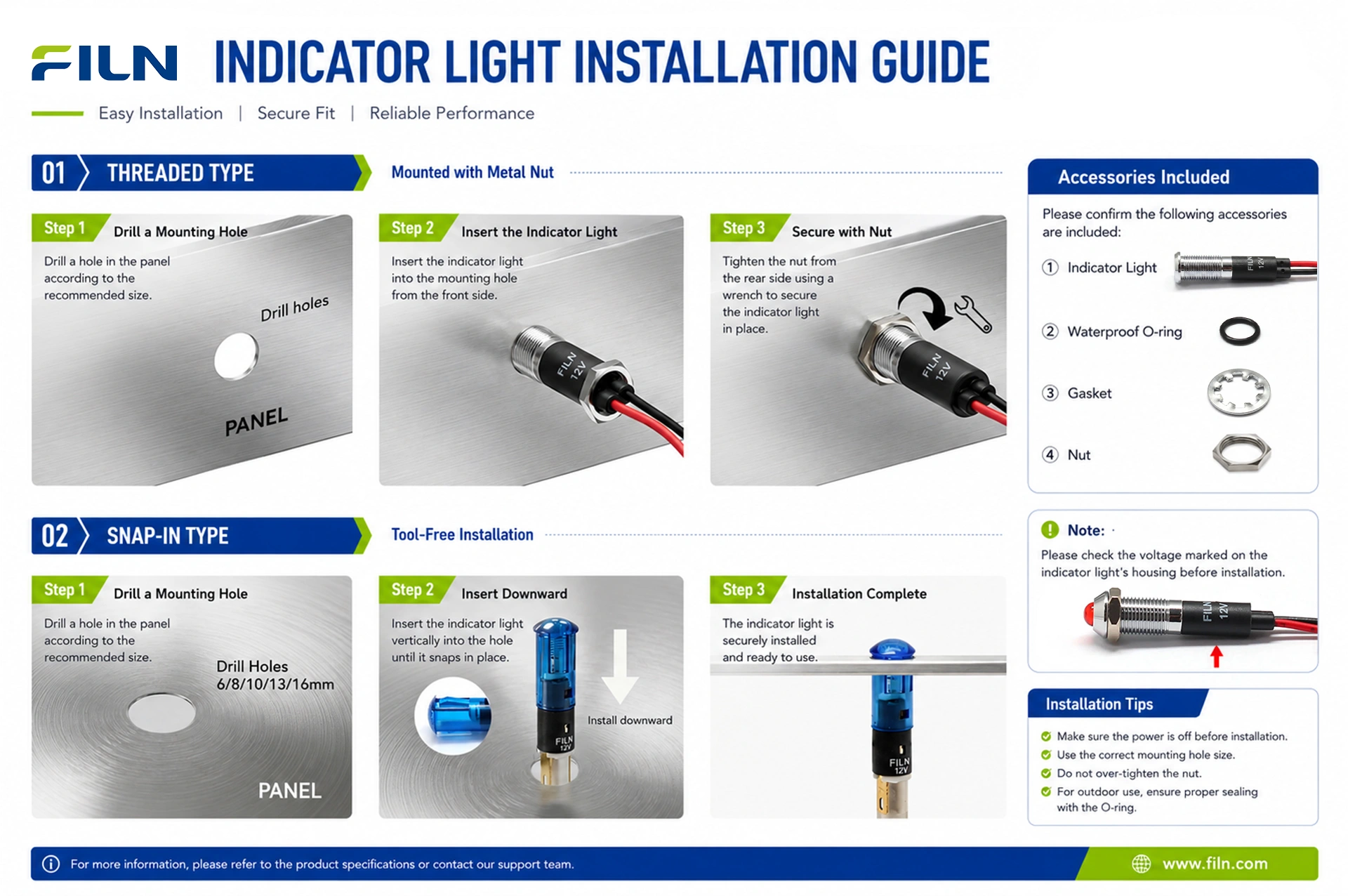
Snap-in installation for this 6mm pilot light indicator is designed for speed on production lines. Always isolate power before cutting, inserting, or wiring—especially on panels that carry 220V AC. Verify panel thickness compatibility for the buckle geometry before volume assembly.
Tools and preparation: round punch or correctly sized drill for a clean 6mm hole, deburring tool, multimeter, and the harness terminals specified by your electrical design. Keep the pilot light indicator lens free of cutting chips.
- Cut a matching round 6mm hole in the product panel at the coordinates shown on the mechanical drawing.
- Insert the pilot light indicator from the front (operator side) of the panel into the opening, keeping the head square to the surface.
- Press until the plastic buckles on both sides catch the panel and the head sits flush without tilt.
- Complete normal wiring on the 2PIN 15cm leads of the pilot light indicator according to the schematic, then inspect retention and illumination on a controlled power-up at the named voltage (for example 220V AC).
Common mistakes include oversized holes that starve buckle engagement, installing from the rear, pinching the lead under a sharp chassis edge, and energizing a polarized pilot light indicator in reverse. Re-check hole diameter and lead routing before sealing the enclosure.
Train operators to listen/feel for buckle engagement when seating the pilot light indicator; a tilted head usually means an irregular hole.
After paint or powder coat touch-ups, re-check that the pilot light indicator buckles still clear the finished thickness.
Keep spare pilot light indicator units in the line kit so a damaged lens never blocks a shipping deadline.
Document the approved punch diameter next to the pilot light indicator callout on the mechanical drawing revision.
Wiring Guide
This FL1P-06QW-2 pilot light indicator uses a 2PIN wire-lead interface with 15cm leads. Disconnect upstream power before any termination work. Follow local electrical safety practice and your equipment directive requirements—especially when the lamp is a 220V AC panel indicator light.
Polarized LED beads require correct DC polarity on the pilot light indicator leads. Non-polar LED beads can be supplied so the lamp may be wired without DC polarity concern when that LED type is selected. State which LED type you need on the RFQ; do not assume a default beyond “available.”
Wire-lead joints on a pilot light indicator may use quick-connect terminals, soldered joints with insulation, or properly insulated twist connections where the harness standard allows. Avoid bare twists without insulation. Strain-relieve the 15cm lead so vibration does not load the LED solder joints inside the body.
Comparison of common termination styles used across panel indicators and related pilot light indicator products:
| Termination style | Advantages | Disadvantages | Typical use scope |
|---|---|---|---|
| Pin-terminal indicator | Compact behind panel; low wire bulk; good for dense PCBs or short jumpers | Needs matching socket/PCB footprint; less flexible routing | Instruments, compact modules, PCB-adjacent panels |
| Plug / pin-style connector indicator | Faster service swap when a mating housing is standardized | Requires connector inventory and polarization keying discipline | Serviceable machines, modular control pods |
| Wire-lead indicator (this page) | Flexible routing; easy harness integration; no PCB footprint required | Lead management needed; length fixed unless customized | Distribution cabinets, appliances, vehicles, general OEM 220V panels |
AC-rated builds of a pilot light indicator must match the named voltage and frequency. Never apply an unconfirmed voltage “to see if it lights,” and never assume a low-voltage sample is interchangeable with a 220V AC production lamp. Request the wiring diagram with your sample if legends on the lead are not yet fixed.
| Ask Wiring Confirmation | Request a Sample |
Dress the 15cm leads of the pilot light indicator away from sharp chassis edges and moving doors.
When ferrules are required by the customer standard, crimp them before final seating of the pilot light indicator if access will be limited.
Torque nearby terminal blocks after the pilot light indicator leads are landed so the harness is not reworked twice.
High-pot planning for a 220V AC cabinet should treat the pilot light indicator leads as part of the energized circuit under test.
Industry Knowledge Center
How a pilot light indicator works: current through the LED junction produces light; the resistor and voltage rating keep that current inside the safe window. Panel designers choose hole size, color, and termination so the lamp is both readable and serviceable on 220V AC or other named circuits.
Why specification discipline matters: mismatched voltage is the most common field failure mode for panel lamps. A low-voltage pilot light indicator on a 220V AC circuit will not behave as a dim lamp — it risks immediate damage. Equally, undersized holes create intermittent buckle retention.
Selection checklist for a plastic pilot light indicator: confirm hole (6mm here), voltage and AC/DC (for example 220V AC), color meaning, polarized vs non-polar LED, wire length, environmental IP needs, and certification paperwork for the destination market.
Common mistakes: ignoring phantom glow on high-impedance AC leakage paths; omitting series resistance on custom LED experiments; treating company capability certificates as automatic proof for every pilot light indicator SKU; and skipping sample fit-checks on actual panel thickness.
Maintenance: clean the lens with a dry or lightly damp cloth; avoid solvents that attack PA66; re-seat buckles after panel repaint; verify lead insulation during scheduled electrical inspections on 220V equipment.
Troubleshooting faint or “phantom” glow: a pilot light indicator may glimmer when leakage current, induced voltage, or high-impedance PLC outputs feed the LED path. Remedies include proper load selection, bleed resistors where engineering-approved, shielded routing, and confirming the LED type. If glow persists at true zero energy, stop and re-test isolation.
Phantom glow tickets should include measured residual voltage at the pilot light indicator nodes with the machine supposedly isolated.
Preventive maintenance routes can include a quick visual sweep of every pilot light indicator for cracked lenses or loose buckles.
Engineering change orders that alter control voltage must cascade to the approved pilot light indicator voltage list the same day—especially when moving between 24V DC and 220V AC standards.
A locked AVL entry for the pilot light indicator prevents unofficial substitutions during shortage periods.
Buyer Decision Guide and RFQ Checklist
B2B procurement for a panel indicator light 220v should treat the pilot light indicator as a controlled component: drawings, approved voltage list, color legend, and incoming inspection criteria belong in the purchase file.
How to choose: start from the panel hole and available depth, then lock electrical ratings (including whether the circuit is truly 220V AC), then cosmetics (color/head), then paperwork (certificates, labeling). Buying considerations include factory customization capability, sample lead communication, and whether wire-lead length matches the harness — here 15cm for this pilot light indicator.
Sizing reference across the plastic family (context for upgrades or alternates):
| Hole size | Typical intent | Note |
|---|---|---|
| 6mm | Very compact HMI and appliance panels; 220V AC status lamps | FL1P-06QW-2 focus on this page |
| 8mm / 10mm | General machinery status lamps | Confirm family availability with FILN |
| 12mm / 16mm / 22mm | Higher visibility or legacy cutouts | May use different mounting hardware |
Certification guide: this page lists CE, VDE, RoHS, ISO9001, and CCC for the stated offering. Always request the certificate PDF that matches the shipped pilot light indicator. Destination-market rules may require additional marks not listed here.
Material selection — plastic housing vs metal housing:
| Housing | Advantages | Limits | Environments |
|---|---|---|---|
| Plastic (PA66) pilot light indicator | Light weight, cost-efficient, insulating body, fast snap-in options | Lower prestige feel; IP and impact needs must be checked | Indoor OEM panels, appliances, volume 220V equipment |
| Metal housing indicator | Robust bezel, certain industrial aesthetics, some harsher fronts | Higher mass and typically higher cost | Premium panels, harsher mechanical exposure |
Specification-to-decision framework for a pilot light indicator:
| Spec | What it means | Why it matters / trade-off | What to confirm |
|---|---|---|---|
| Mounting hole 6mm | Defines cutout tooling | Larger holes increase visibility but consume panel space | Confirm punch size and tolerance |
| Voltage 3–480V custom (often 220V AC) | Matches control circuit | Wrong voltage destroys LEDs | State exact V and AC/DC on PO |
| Wire lead 15cm 2PIN | Harness reach | Too short forces splices; too long adds bulk | Ask for custom length if needed |
| LED color | Operator meaning | Ambiguous colors cause human error | Publish legend in the manual |
| IP50 series typical | Particle protection level | Not a wash-down rating | Choose another family if wet locations |
| Certifications listed | Market access paperwork | Missing files delay customs/QA | Request certs with the quotation |
RFQ checklist — send the following when requesting a pilot light indicator quotation: product type; model FL1P-06QW-2 or alternate; mounting hole; voltage (for example 220V AC); AC/DC; LED color; head type; material; waterproof/IP requirement; wiring method; wire length; connector; certification requirement; quantity; packaging; OEM/ODM needs; logo/custom marking; target market; application environment; expected delivery date discussion (date itself is commercial — confirm with FILN, do not assume).
Providing these specifications helps FILN engineering and sales teams confirm product compatibility and quotation requirements more efficiently. MOQ, price, and lead time are configuration- and order-dependent — confirm with FILN.
| Request Quotation / RFQ | Request a Sample |
| Request Datasheet | Request 3D Model |
| Purchase on cnfiln.com |
Procurement scorecards for a pilot light indicator supplier usually weigh sample speed, certificate completeness, and configuration control.
Blanket orders should still line-break each pilot light indicator voltage and color to keep MRP accurate—separate 220V AC lines from low-voltage DC lines.
Ask FILN for packaging photos if retail-ready or kitted pilot light indicator packs are required for downstream channel partners.
Customs files benefit when the commercial invoice description matches this pilot light indicator wording used on the packing list.
FILN Manufacturing and Engineering Capabilities
FILN operates as a manufacturer of industrial indicating and switching components, including plastic and metal panel lamps for buyers who need a reliable panel indicator light 220v build. Buyers working a new pilot light indicator into a platform can request engineering review of voltage builds, lead exits, and panel fit.
Capability areas that matter to procurement: R&D support for custom ratings including 220V AC; OEM and ODM marking; production and assembly lines for repeatable output; incoming and outgoing inspection; laboratory testing support; certification paperwork assistance for the configurations under discussion; export packing; sample builds; and communication in engineering terms rather than retail slogans.
Each capability maps to a buyer benefit: fewer redesign loops on the pilot light indicator, clearer PPAP-style evidence when requested, and a single factory contact for datasheet, CAD, and quotation follow-up. Claims here are process capabilities — not a promise that every historical certificate applies to every SKU automatically.

| Discuss OEM / ODM Project |
Early DFM calls reduce late changes to the pilot light indicator lead exit or resistor value after tooling quotes are frozen.
OEM laser marking or custom sleeve printing on a pilot light indicator lead set should be requested before the first mass run.
Stable supply planning works best when forecast horizons for each pilot light indicator color and voltage—including 220V AC—are shared with the factory.
Factory Direct Supply
Yueqing Yulin Electronic Co., Ltd., branding products as FILN, is based in Wenzhou, Zhejiang, and has operated since 2006 with integrated R&D, production, and sales. The organization reports product reach in 100+ countries, a facility on the order of 10,000 m², 20+ production lines, an independent testing laboratory, and an ISO9001 quality system. These are factory facts for supplier qualification of a pilot light indicator source.
Product scope includes indicator lights, push-button switches, rocker switches, toggle switches, and related custom small electrical parts. When comparing suppliers of a panel indicator light 220v, factory-direct communication shortens the path from drawing change to sample.
Separation note: company or product-line capabilities may reference broader marks used across FILN categories. For this plastic pilot light indicator page, the certifications explicitly stated for the offering are CE, VDE, RoHS, ISO9001, and CCC. Always obtain the matching certificate file for the shipped configuration.

Company website:
https://www.filn.com
| Sales catalog product page:
Buy 6mm panel mount LED indicator
| Factory RFQ | Request Datasheet |
| Request 3D Model | Buy This 6mm Indicator |
Supplier qualification teams can tour process flows that build the pilot light indicator alongside related switch products in the same campus.
Factory-direct escalation paths help when a pilot light indicator lot needs rapid optical revalidation for a customer audit.
Long-term agreements should reference the controlled drawing of the pilot light indicator rather than only a marketing nickname.
Frequently Asked Questions
Q1. What is a FILN panel indicator light 220V used for?
FILN panel indicator light 220v configurations provide panel status indication on electrical equipment, laboratory devices, distribution cabinets, new-energy systems, yachts, appliances, and automotive modification projects that need a mains-class status lamp. The FL1P-6QW-2 pilot light indicator is a 6mm snap-in plastic round lamp with 2PIN wire leads. Review factory capabilities at www.filn.com or open the product purchase page.
Q2. What mounting hole does the FL1P-06QW-2 pilot light indicator require?
The cutout is 6mm. Install the pilot light indicator from the front of the panel so the side plastic buckles catch the sheet. Deburr the hole before insertion. For nearby sizes in the same plastic family, see more 6mm plastic indicator lights.
Q3. Can this panel indicator light be ordered as 220V AC?
Yes. Many OEM drawings specify a 220V AC panel indicator light. Voltage is offered across 3–480V and can be customized; confirm exact AC or DC rating, frequency for AC builds, and LED color before ordering. Email voltage customization to inquiry@cnylin.com.cn.
Q4. How long is the wire lead on this pilot light indicator?
The stated 2PIN wire-lead length is 15cm. If your harness needs a different length or termination, request OEM wire prep in the RFQ. You can also view the catalog product entry while preparing drawings.
Q5. Can I wire the pilot light indicator without observing LED polarity?
Yes — when a non-polar LED bead is selected for the pilot light indicator, DC polarity is not required. Polarized LED beads remain available when your standard calls for them. Specify the LED type clearly on the purchase documents and confirm with FILN.
Q6. What certifications are stated for this pilot light indicator page?
This page lists CE, VDE, RoHS, ISO9001, and CCC for the stated offering. Request the certificate PDFs that match the shipped configuration. Company information is available at https://www.filn.com.
Q7. How does a plastic pilot light indicator compare with a metal indicator?
A plastic pilot light indicator is typically lighter and more cost-efficient for indoor OEM panels—including many 220V AC cabinets—while metal bodies offer a different mechanical presence and may suit harsher fronts. Series-typical protection here is IP50 — not an automatic wet-location rating. Compare families in the panel indicator lights category.
Q8. Why does my pilot light indicator show a faint glow when the machine is off?
Phantom glow on an LED pilot light indicator often comes from leakage current, induced voltage, or high-impedance outputs still feeding the lamp path—especially on AC panels. Verify true isolation, review bleed-resistor strategies with your electrical engineer, and confirm LED type. Contact FILN engineering via inquiry@cnylin.com.cn with your schematic notes.
Q9. How do I request a sample, datasheet, or 3D model for this pilot light indicator?
Send a structured RFQ with hole size, voltage (for example 220V AC), color, and quantity intent. Use Request a Sample, Request Datasheet, or Request 3D Model. Purchasing links remain on cnfiln.com.
Q10. Where can procurement teams buy or specify this factory panel indicator light 220V?
Procurement can purchase via the sales catalog at https://www.cnfiln.com/products/6mm-12v-panel-mount-led-indicator-light, review the manufacturer site at https://www.filn.com, or email inquiry@cnylin.com.cn for factory quotation. MOQ and lead time are confirm-with-FILN items.