Key Takeaways
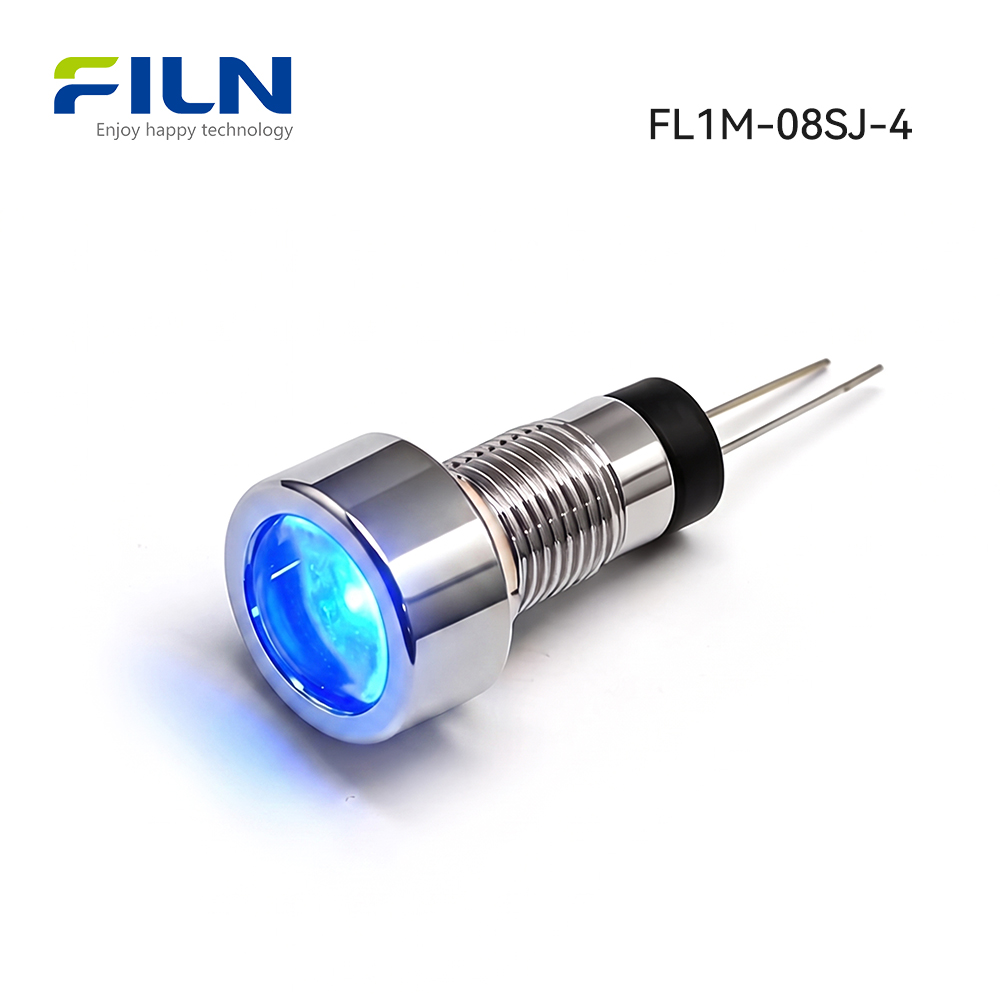
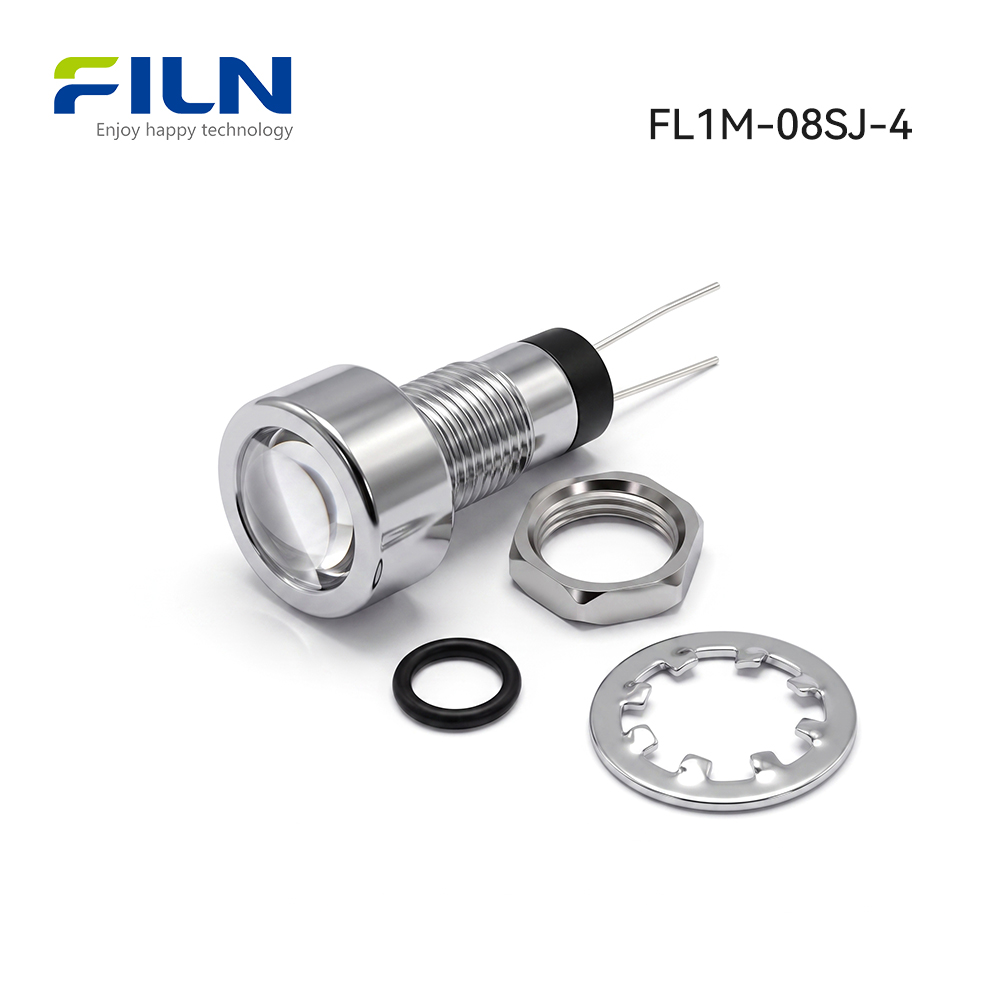
- Industrial Strength Housing: Constructed from premium copper or zinc-aluminum alloy with an optional sleek black finish to outperform brittle plastic variants under impact.
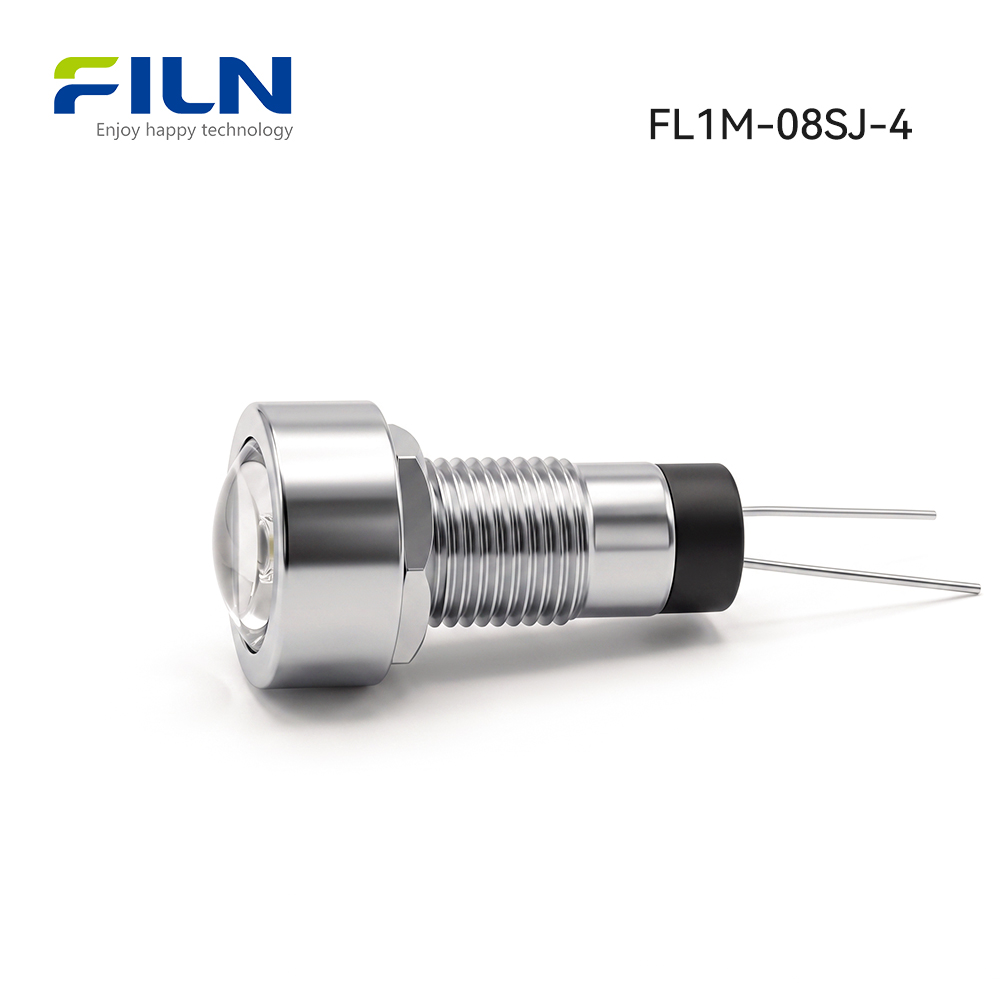
- High-Visibility Convex Lens: Designed with an elevated convex head profile that enhances wide-angle visual acknowledgement across active factory floors.
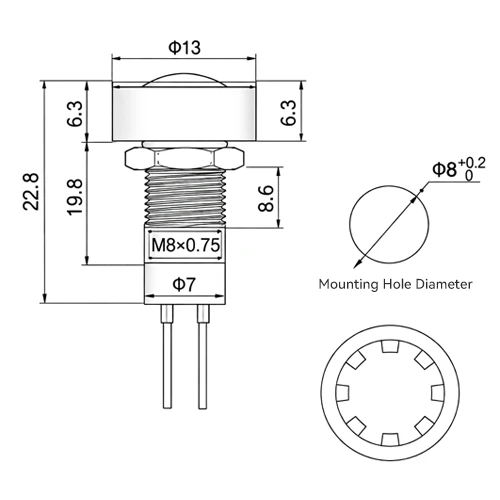
- Compact 8mm Cutout: Minimizes total control panel real estate requirements while ensuring bright, high-density signaling matrices.
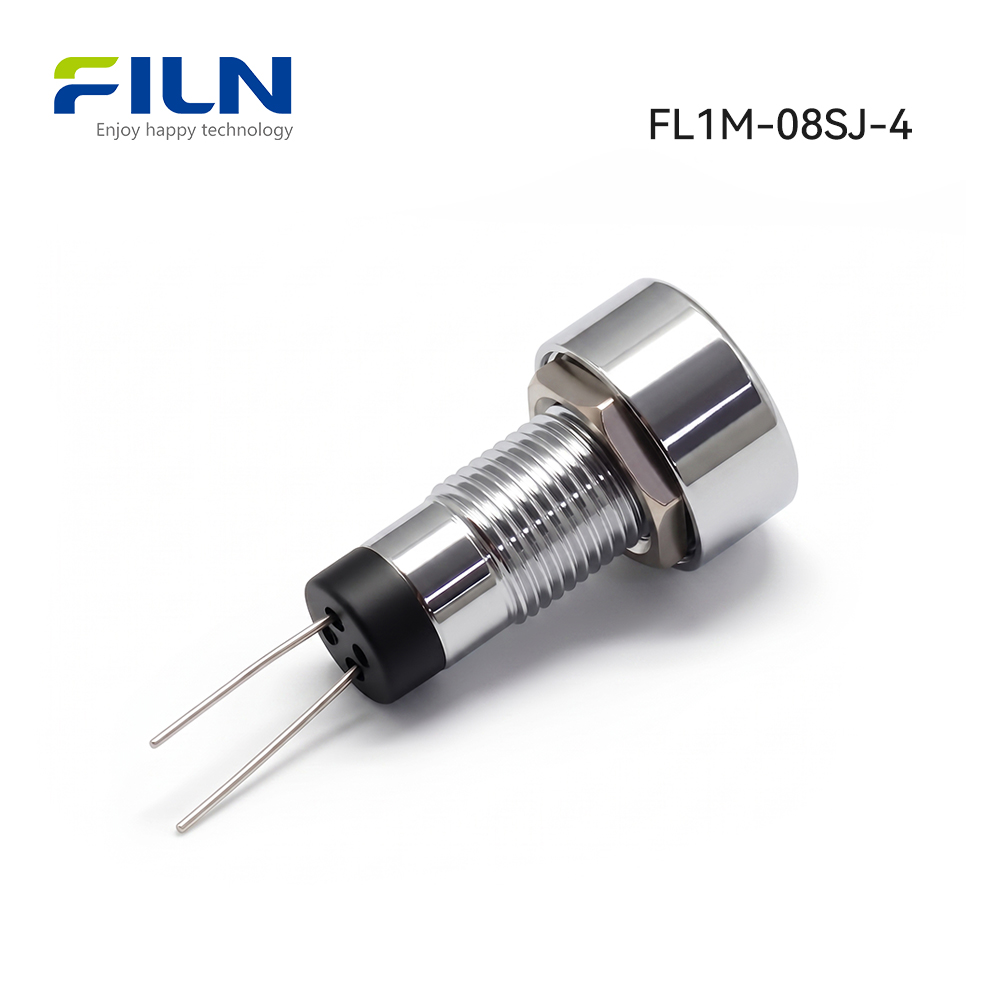
- Streamlined 2PIN Terminals: Employs rigid pin terminals optimized for stable soldering or quick-mating plug connections to limit operational wiring labor.
- IP65 Sealing Protection: Includes a dedicated silicone O-ring gasket that completely seals out moisture, grease, and airborne debris.
- Broad Global Compliance: Fully authorized with CE, VDE, RoHS, CCC, and ISO9001 certifications ensuring direct entry into high-specification B2B environments.
- Extended Operating Lifespan: Integrated solid-state LED chips maintain stable luminous intensity for up to 100,000 active operating hours.
- Wide Voltage Adaptability: Nominally optimized for 120V systems, with engineering support available for custom ranges spanning 3V to 220V AC/DC.
- Comprehensive Hardware Kit: Ships as a complete package containing 1x Indicator Light, 1x Waterproof Ring, 1x Compression Gasket, and 1x M6 Hex Nut.
What are 120v Led Panel Indicator Lights?
Industrial 120v led panel indicator lights are specialized, panel-mounted optoelectronic signaling devices engineered to communicate the operational status of electrical circuits, heavy machinery, and automated control logic. Comprising an integrated solid-state light-emitting diode, a voltage-dropping resistor network, and a ruggedized external protective housing, these components transform electrical energy into a localized visual cue. They serve as critical components within control interfaces, allowing machine operators to safely monitor system power, operational states, fault conditions, and safety interlocks from a distance.
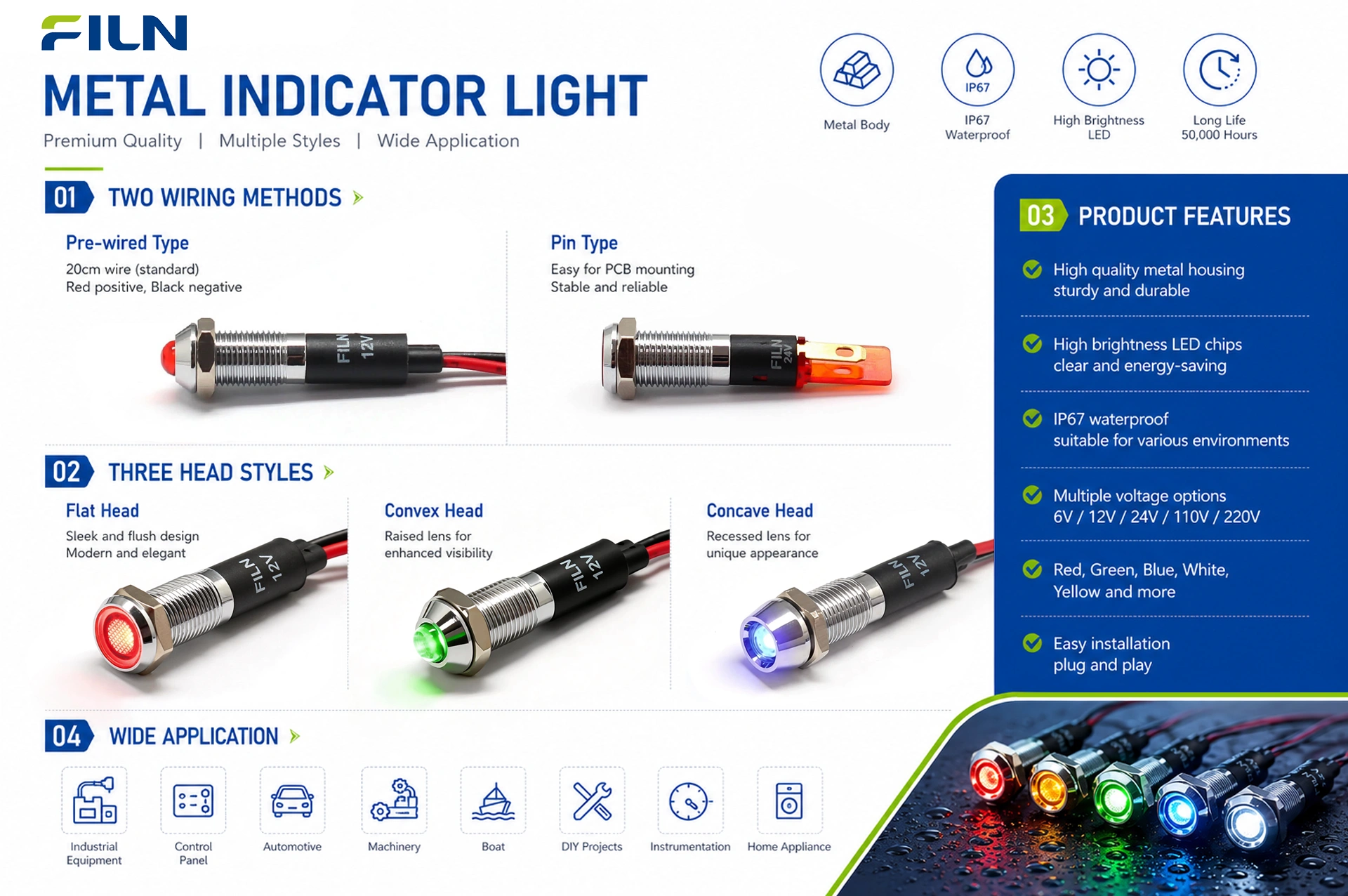
FILN provides an expansive lineup of indicator choices to satisfy diverse industrial design standards, including premium metal indicator configurations and economical plastic indicator lines, with mounting diameters ranging broadly from 6mm up to 30mm. Depending on specific cabinet layout requirements and field assembly workflows, builders can select either rigid terminal pins or pre-wired insulated wire leads. The premium metal indicators feature three distinct structural face aesthetics—including flat heads, elevated convex heads, and recessed concave heads—allowing engineers to select the exact tactile profile required for optimal visibility and protection.
Product Overview & Comprehensive Functional Analysis
The FILN FL1M-08SJ-4 series utilizes a robust optoelectronic architecture to deliver reliable status tracking within high-voltage environments. Its primary internal mechanical principle relies on a heavy-duty threaded barrel design secured via a precise hex nut assembly, maintaining structural stability against heavy structural vibration. Mechanically, the convex head design provides a wider viewing angle than flat variants, guaranteeing that operators can identify system alerts from both oblique and frontal viewpoints.
From an electrical standpoint, the internal circuitry features an advanced current-limiting internal carbon film resistor paired directly with a high-efficiency luminescent LED chip. This configuration allows the lamp to accept a standard 120V AC input voltage directly, keeping operating current below 20mA to avoid unnecessary power loss or overheating. The rugged shell acts as an electrical shield, providing high dielectric resistance and complete isolation between the primary internal conductor elements and the exterior control enclosure.
This specific combination of mechanical strength and high electrical performance makes the FL1M-08SJ-4 well-suited for deployment across advanced power generation cabinets, medical sterilizers, commercial processing equipment, and automated production cells. Backed by recognized CE, VDE, and RoHS compliance certificates, this indicator series uses high-purity PA66 bases and impact-resistant polycarbonate lampshades. These premium materials resist chemical washdowns and thermal cycling, ensuring reliable service life without yellowing or structural failure.
Quick Specifications
The detailed mechanical and aesthetic specifications below define the precise boundaries for integration of the FL1M-08SJ-4 component into new or retrofitted layout arrangements.
| Specification Parameter |
Technical Data Value |
| Description |
Metal indicator light with 2PIN terminals |
| Model Number |
FL1M-08SJ-4 |
| Mounting Hole Diameter |
8mm (0.315 Inches) |
| Operational Voltage Range |
120V AC (Customizable range from 3V to 220V AC/DC) |
| Available LED Colors |
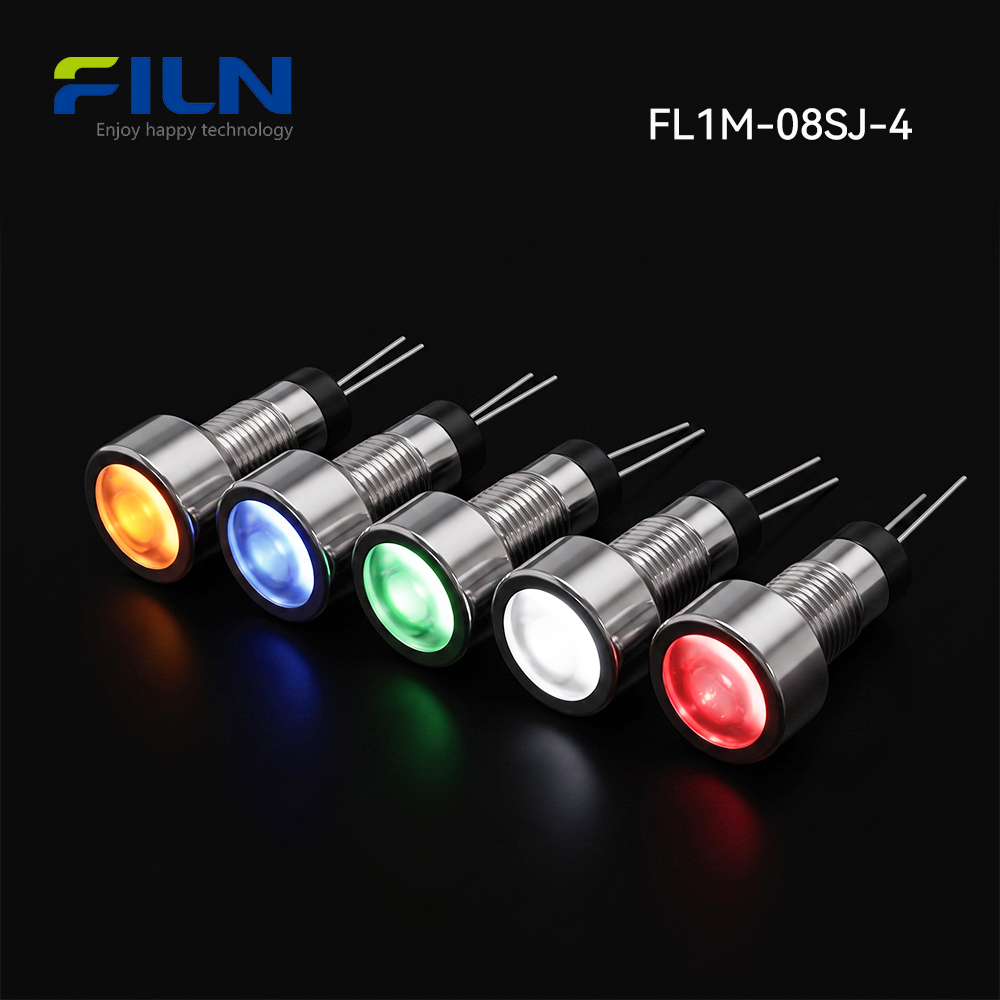
Red (R) / Green (G) / Yellow (Y) / Blue (B) / White (W) |
| Ingress Protection Rating |
IP65 / IP67 Equivalent with sealing gasket |
| Wiring & Connection Type |
2PIN Quick Connect / Solder Terminals |
| Head Profile |
Convex Head Shape / (High contrast profile) |
| Surface Quality |
Smooth finish, free of burrs, oxidation defects, or structural micro-cracks |
| Mechanical Assembly Quality |
Firm interlocking barrel-to-base alignment; zero rotation, distortion, or loose fittings |
Note: For physical design validation inside tight electrical panels, procurement groups can request official 2D drawings or 3D CAD modeling assets directly through our engineering department.
Performance Parameters
The detailed electrical performance standards, mechanical limits, and lifecycle statistics below outline the capabilities of the FL1M-08SJ-4 under typical operating conditions.
| Performance Parameter |
Value / Measurement Metric |
| Rated Working Voltage |
3V to 240V DC / AC (Optimized at 120V AC, factory customizable) |
| AC Power Frequency |
50 Hz to 60 Hz |
| Rated Operating Current |
≤ 20 mA |
| Total Power Consumption |
Approximately 0.2 W |
| Insulation Resistance |
≥ 100 MΩ (Measured applying 500V DC between internal conductors and external shell) |
| Dielectric Strength |
1500V to 1800V AC; zero dielectric breakdown, flashover, or tracking anomalies |
| Operational Working Life |
50,000 Hours to 100,000 Hours continuous duty |
| Waterproof Rating |
IP67 Enclosure Integrity (Dust-tight and proof against short immersion) |
Component Materials & Structural Composition
Selecting high-grade materials protects the indicator from early degradation caused by chemical exposure, vibration fatigue, and structural stress.
| Accessory Name |
Material Selected |
Engineering Justification & Performance Benefit |
| External Housing Shell |
Copper Alloy / Zinc-Aluminum Alloy (Optional Black Plating) |
Provides structural defense against impact and drops, and resists industrial solvent degradation. |
| Internal Lamp Holder |
Polyamide 66 (PA66 Nylon) |
Delivers exceptional mechanical insulation properties alongside outstanding thermal deformation resistance. |
| Optical Lampshade |
Polycarbonate (PC) |
Ensures high light transmission metrics combined with high shatterproof safety characteristics. |
| Luminescent Source |
High-Brightness Solid State LED Matrix |
Provides consistent luminous flux output while generating low thermal waste across extensive operating spans. |
| Internal Resistor |
Carbon Film Resistance Structure |
Maintains long-term value stability to prevent overcurrent events from damaging the LED chip. |
| Internal Connection Wireway |
Premium Polyvinyl Chloride (PVC) Insulation |
Maintains excellent dielectric properties and prevents short circuits inside tight wiring harnesses. |
| Hexagonal Mounting Nut |
Machined Copper Alloy (Nickel/Chrome Coated) |
Resists thread stripping and ensures consistent holding tension when torqued during initial panel installation. |
| Sealing O-Ring Element |
Industrial-Grade Silicone Rubber (Silica Gel) |
Forms an airtight front enclosure seal that resists ozone exposure, temperature shifts, and moisture ingress. |
| Plum Blossom Gasket |
Austenitic Stainless Steel |
Bites firmly into the backside panel plate, preventing the indicator assembly from loosening due to machine vibration. |
Environmental Performance & Durability Testing Baseline
These testing standards outline the performance limits for the Indicator Light series metal indicator housings across demanding field operating conditions.
| Environmental Stress Test Category |
Applied Testing Protocol & Parameters |
| General Field Application Intent |
Standardized operating boundaries for general-use high-durability Indicator Light series components. |
| Part Classification Nomenclature |
Ruggedized Metal Indicator Light Module |
| Operating & Storage Temperature |
Limits range from -40°C up to +80°C |
| Operating Relative Humidity Envelope |
Maintains operational integrity at ≤85% relative humidity measured at +40°C |
| High Temperature Endurance Profile |
Withstands continuous exposure for 96 hours at 80±2°C without lens distortion or insulation failure. |
| Low Temperature Cryogenic Trial |
Withstands continuous exposure for 96 hours at -40±2°C with zero material embrittlement. |
| Constant Temperature & Humidity Test |
Tested for 96 hours at 40±2°C with relative humidity controlled between 90% and 95% RH. |
| Thermal Temperature Cycling Profile |
Alternates between -40°C (30 min) and +85°C (30 min) for 5 complete cycles; zero seal failure. |
LED Die Semiconductor Technical Specifications
1. Absolute Maximum Ratings
These critical electrical limits define the safe operating boundaries for the internal LED chip matrix to prevent permanent degradation or early failure.
| Electrical/Thermal Boundary Condition |
Absolute Maximum Limit Value |
| Maximum Peak Forward Current (IFP) |
20 mA |
| Maximum Allowable Reverse Voltage (VR) |
5 V |
| Total Safe Power Dissipation Profile (PD) |
60 mW |
| Safe Operating Temperature Envelope (TOPR) |
-40°C to +80°C |
| Long-Term Storage Temperature Range (TSTG) |
-40°C to +100°C |
| Lead-Free Reflow/Solder Heat Threshold (TSOL) |
Maximum 260°C strictly maintained for a duration under 3 seconds |
2. Electro-Optical Performance Characteristics
The parameters below outline the expected optical output and diode voltage characteristics evaluated at an ambient temperature baseline of Ta=25°C.
| Electro-Optical Parameter Evaluated |
Testing Verification Conditions |
Performance Target Ranges |
| Diode Forward Voltage (VF) |
Evaluated at IF = 20mA |
Minimum: 2.8V | Maximum: 3.2V |
| Leakage Reverse Current (IR) |
Evaluated at VR = 5V |
Maximum Upper Ceiling: 5 μA |
| Luminous Spatial Viewing Angle (2θ½) |
Evaluated at IF = 20mA |
Typical Value Target: 60° |
| Luminous Intensity Output Range |
Evaluated at IF = 20mA |
Minimum: 500 mcd | Maximum: 800 mcd |
| Recommended Driving Current (IF) |
Continuous Duty Profile |
Typical Constant Value: 20 mA |
| Dominant Spectrum Wavelength (λd) |
Evaluated at IF = 20mA (Green Core) |
Spectral Interval: 520 nm to 525 nm |
| Maximum Internal Junction Temp (Tj) |
Evaluated at IF = 20mA |
Upper Limit: 125°C |
| Semiconductor Thermal Resistance (RJP) |
Evaluated at IF = 20mA |
Typical Characterization: 8°C/W |
Standardized Testing Conditions & Calibration Baselines
Unless explicitly noted otherwise via specialized manufacturing addendums, all electrical, physical, and optoelectronic performance figures listed are validated under the following environmental baseline parameters:
| Environmental Baseline Parameter |
Standard Baseline Testing Range Required |
| Ambient Air Testing Temperature |
Controlled between 5°C and 35°C |
| Relative Atmospheric Humidity Level |
Controlled between 45% and 85% RH |
| Barometric Air Pressure Tracking |
86 kPa to 106 kPa (Equivalent to 860 mbar to 1060 mbar) |
Technical Reference Notes: Luminous intensity outputs along with dominant spectral color coordinates are completely calibrated and verified in accordance with the official CIE international standard eye response curve. The integrated testing equipment introduces an absolute tolerance of ±15% regarding luminous intensity measurements, and a precise tolerance of ±0.1V regarding forward voltage measurement parameters.
Cross-Industry Applications & Industrial Deployment Scenarios
Equipped with a high-strength copper alloy or stainless steel shell, FILN metal indicator lamps provide robust impact resistance and IP67-rated ingress defense. Standard plastic alternative components often experience early fracturing, cracking, and thermal deformation when subjected to harsh, high-temperature settings. In contrast, heavy-duty metal indicators are engineered to withstand continuous mechanical vibration and frequent washdowns across critical infrastructure and commercial environments.
I. Industrial Automation & Machinery Manufacturing
Automated assembly spaces contain high mechanical vibration, cutting fluids, and physical impacts. On CNC machine tools and advanced machining centers, multi-color metal pilot lamps display system runtime context (green for normal cycle execution, yellow indicating active standby/holding presets, and red for active faults). Their sturdy metallic outer sleeves prevent structural corrosion from cooling lubricants and flying metal shavings. For large-scale PLC distribution enclosures, the 8mm convex indicator provides reliable electrical status tracking while resisting connection failures caused by physical cabinet vibrations.
II. Outdoor Electrical Enclosures & Renewable Energy Systems
Outdoor grid installations face severe environmental exposure, rapid temperature swings, and UV rays that degrade standard non-metallic indicators. Outdoor DC/AC EV charging kiosks use these convex indicator lamps to display current charging states (flashing blue or green indicating current flow, solid green for complete charging cycles, and flashing red signaling ground faults or active leakage threats). Their IP67 sealing and solid construction protect against vandalism in public spaces, while maintaining reliable performance from -40°C to +80°C.
III. Rail Transit, Heavy Engineering Vehicles & Marine Gear
Mobile heavy machinery creates continuous mechanical shocks, while marine infrastructure introduces salt spray corrosion risks. Operators rely on metal panel lamps installed in heavy excavator, crane, and bulldozer dashboards to monitor critical fluid indicators like oil pressure, engine temperature, and braking status. Marine control bridges and deck-mounted hardware utilize chromium or nickel-plated bodies fitted with tight silicone O-rings to prevent saltwater ingress and resist salt-fog corrosion.
IV. Commercial Self-Service Terminals & Vandal-Prone Public Facilities
Unsupervised public terminals require robust components to minimize downtime and prevent vandalism. Automated vending systems and ticket kiosks use metal indicator modules to provide simple, clear status signals for coin validation, product selection, and change return cycles. Fuel dispensing pump interfaces utilize the excellent electrical isolation of metal shells to meet strict safety protocols, while outdoor security intercoms use flush metal indicators to clearly show lock states.
V. Medical Equipment & Food Processing Machinery
Hygienic manufacturing lines require frequent high-pressure chemical washdowns and thermal sterilization. Food packaging lines use IP67 metal pilot lamps that withstand hot water sprays and caustic sanitizing agents without fogging or chemical breakdown. High-pressure medical autoclaves also utilize these heat-resistant indicators to track heating, sterilization, and pressure venting cycles safely.
Industrial Luminous Color Code Standards & Functional Significance
Standardized color coding is essential for workplace safety and efficient machinery operation across international manufacturing facilities. The list below outlines the operational meanings of the five primary signaling colors under international compliance rules:
- RED (Emergency / Fault / Danger): Indicates immediate, critical operational threats such as emergency stop activation, system overheating, or lubrication pressure drop. It requires immediate operator intervention to prevent equipment damage or personal injury.
- GREEN (Normal Execution / Safe Operation): Confirms that automated systems are operating within safe parameters. It signifies that the equipment is fully prepared for safe initialization or is executing a normal production cycle.
- YELLOW / AMBER (Warning / Deviation / Pre-Fault Alert): Signals that the system is operating near its thermal or electrical boundaries, or that an automated process is transitioning. It alerts operators to monitor parameters before a critical failure occurs.
- BLUE (Mandatory Action Required / Process Overrides): Indicates that a specific manual intervention or preset sequence update is required, such as resetting an automated tracking log or introducing new raw stock materials.
- WHITE (System Status Monitor / Power Present): Serves as a neutral indicator confirming primary source power availability or indicating that a system component is currently active.
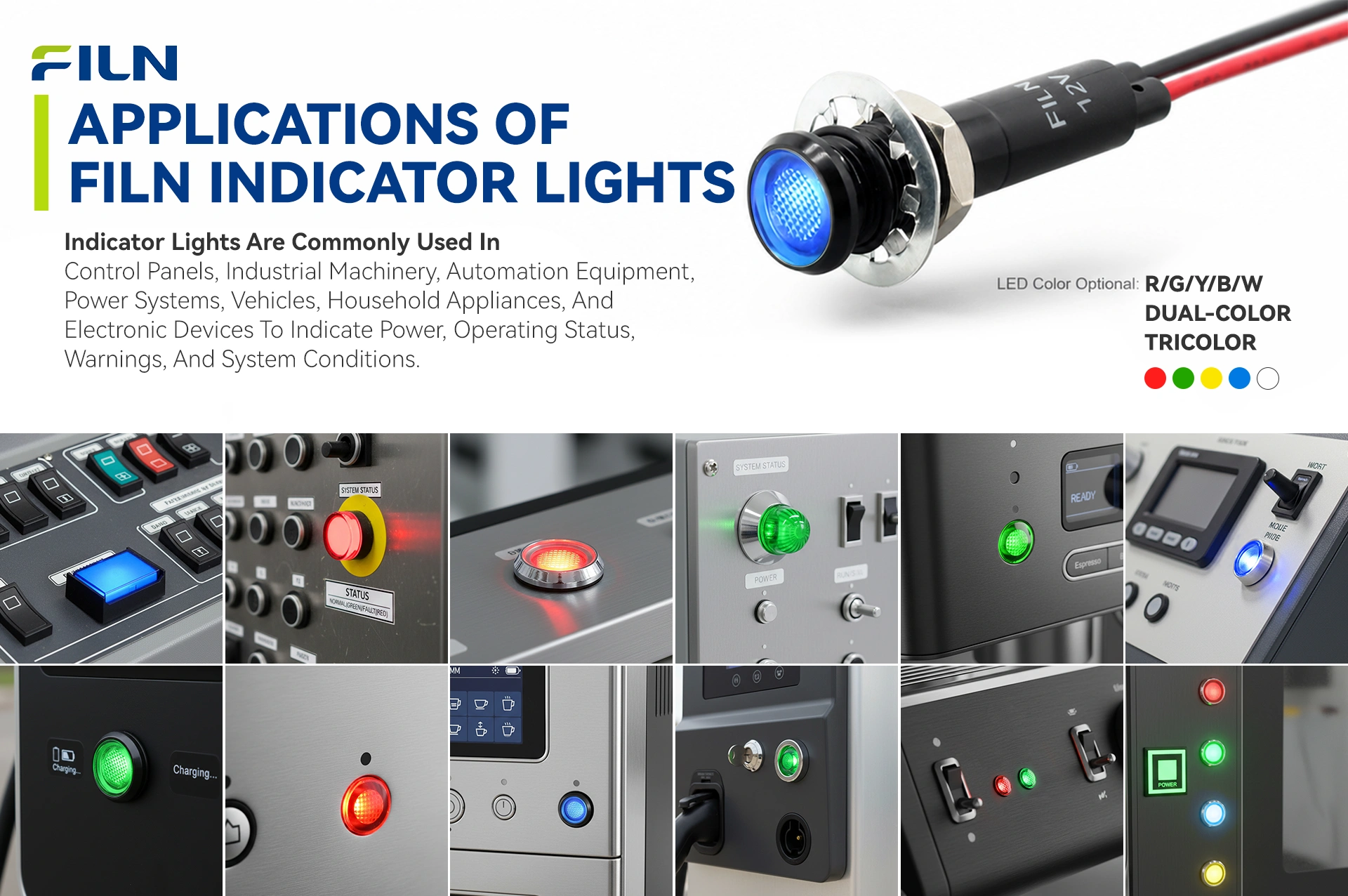
To meet complex automation signaling needs, FILN produces advanced dual-color and multi-color indicator lights. These space-saving variants combine multiple colored LED dies inside a single 8mm metal housing, allowing a single panel location to display multiple system states.
Step-by-Step Mechanical Installation Guide
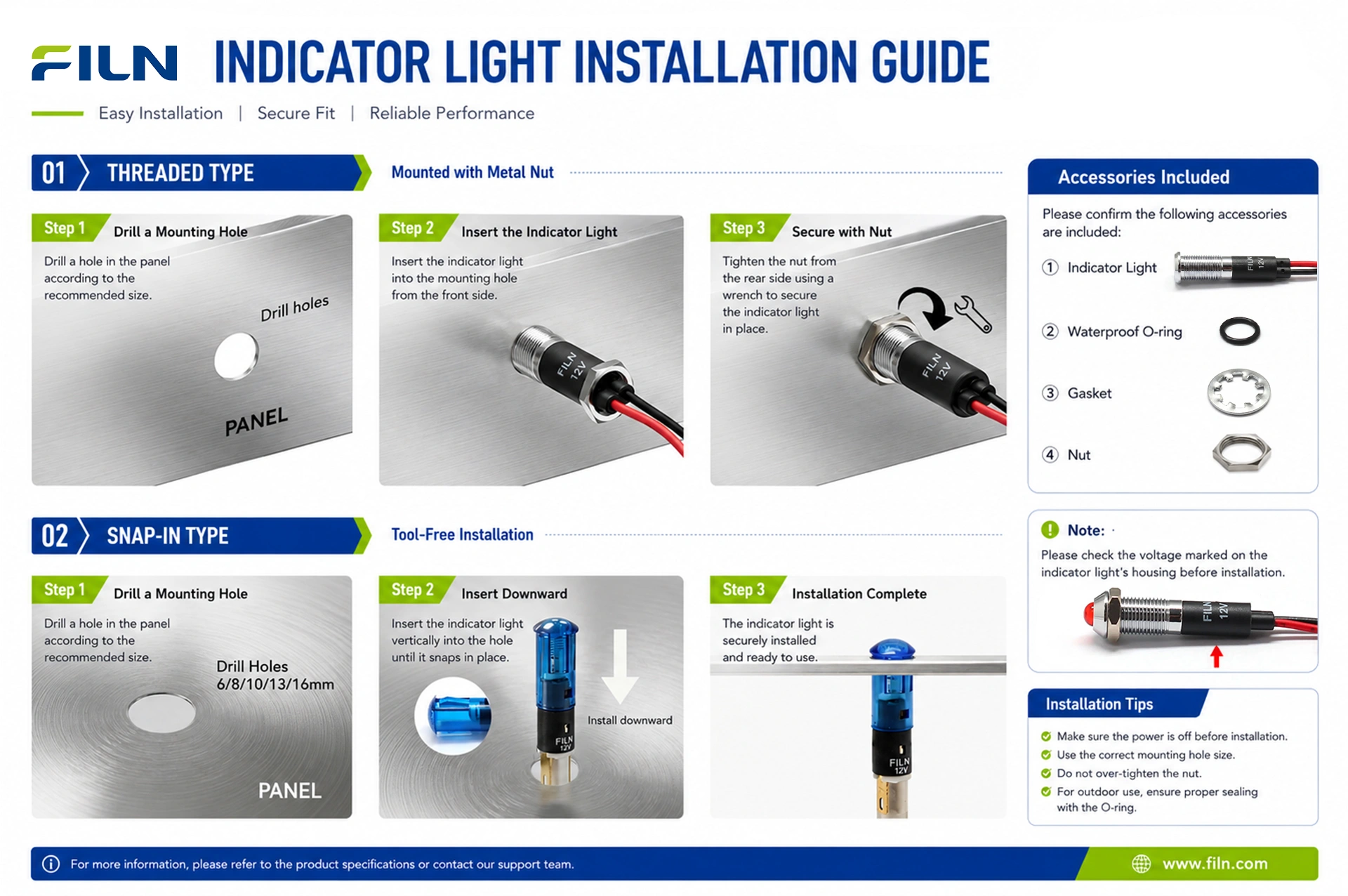
Follow this installation procedure to mount the 8mm threaded convex indicator lamp into an instrument panel array, ensuring a secure fit and reliable IP65 waterproof sealing:
- Isolate Panel Power: Disconnect all upstream circuit breakers and verify the panel is completely de-energized before beginning installation.
- Drill the Mounting Cutout: Execute a precise 8mm circular cutout in the instrument panel using a step drill bit, then deburr the hole edges to remove sharp metal fragments.
- Position Sealing Ring: Slide the included silicone rubber O-ring onto the threaded metal indicator barrel, pressing it flat against the underside of the convex head.
- Insert the Indicator: Push the terminal pins and threaded barrel through the front face of the 8mm panel cutout until the silicone seal rests flat against the exterior surface.
- Secure Rear Hardware: From the backside of the panel, slide the flat stainless steel compression gasket over the 2PIN terminals and onto the threaded housing.
- Tighten Locking Nut: Thread the M6 metal hex nut onto the barrel and torque it smoothly using a wrench, compressing the front silicone seal to establish an airtight IP65 water barrier.
- Terminate Wiring Leads: Attach your electrical supply lines to the 2PIN terminals using direct solder joints or quick-connect push-on terminals.
Electrical Termination & Terminal Wiring Protocol
Proper terminal connections are essential for preventing resistance spikes or localized circuit failures caused by machine movement or thermal expansion. The table below compares the functional advantages of pin terminals, tab terminals, and wire lead connection types:
| Connection Interface Style |
Primary Operational Advantages |
Potential Drawbacks / Constraints |
| Rigid Pin Terminals (2PIN Style) |
Provides a compact, rigid footprint ideal for direct PCB soldering or custom quick-connect wire housings. |
Requires manual hand soldering or specific matching connector plugs during final system installation. |
| Flat Spade/Tab Terminals |
Enables fast field replacement using standardized female push-on crimp connectors without heat tools. |
Demands more clearance depth behind the control panel to accommodate the larger quick-disconnect blade profiles. |
| Pre-Wired Pigtail Leads |
Completely eliminates field soldering steps; allows direct connection to terminal blocks or wiring harnesses. |
Wire bundle length is fixed during manufacturing, requiring neat splicing if runs exceed standard pigtail limits. |
When wiring pre-wired pigtail models, ensure reliable electrical contact by joining wires using spring-loaded lever blocks, standard crimp sleeves, or soldered inline splices wrapped with heavy-duty heat-shrink tubing. Always verify that all upstream power is fully disconnected before handling exposed conductors to prevent electrical shock or damage to the internal LED chip.
Industrial Signaling Knowledge Base
Understanding basic electrical engineering principles helps prevent common integration errors and extends the service life of panel components.
Mitigating Residual Voltage & Ghost Illumination
A common issue in complex automation panels is “ghost illumination,” where an LED indicator glows faintly even when its control circuit is turned off. This occurs because highly sensitive solid-state LED dies can be energized by small leakage currents, electromagnetic coupling from parallel AC wiring runs, or residual PLC leakage. To prevent ghost illumination, engineers can integrate a parallel bleeder resistor or a bypass zener diode circuit, which diverts low-level leakage currents away from the LED chip.
Enclosure Integrity & Chemical Resistance Standards
Selecting an indicator requires matching its ingress protection rating with the operating environment. Standard IP65 housings protect against light dust and low-pressure water sprays, making them suitable for typical indoor control setups. For harsher settings, such as food processing lines or chemical plants that undergo high-pressure washdowns, true IP67 or IP69K rated metal components are necessary to prevent moisture from passing the front panel seal and causing internal short circuits.
Procurement Decision Guide & Component Sourcing Criteria
B2B buyers should evaluate the following key parameters when sourcing panel-mounted indicators to ensure long-term compatibility with their equipment designs:
- Voltage Configuration Match: Verify the circuit supply voltage matches the internal resistor rating (e.g., 120V AC for standard North American power) to avoid dimming or early chip failure.
- Panel Thickness Limits: Confirm the threaded barrel length provides enough clearance to fit through your panel plate while leaving enough thread to fully tighten the rear locking hardware.
- Regulatory Compliance: Ensure components carry valid certifications like CE, UL, VDE, or RoHS to streamline final product approval and entry into international markets.
- Environmental Exposure Factors: Use corrosion-resistant chrome-plated brass or stainless steel housings for outdoor or high-humidity installations instead of standard plastics.
Why Procurement Engineers Partner with FILN
FILN operates as a direct manufacturer, eliminating middleman markups to provide highly competitive volume pricing, custom electrical tailoring, and fast production lead times. With no strict Minimum Order Quantity (MOQ) limits, we help engineering teams smoothly scale from initial prototyping up to full mass production.
Founded in 2006, Yueqing Yulin Electronic Co., Ltd. (operating under the global brand name FILN) is based in Wenzhou, Zhejiang. Over the past two decades, we have grown into a specialized manufacturer integrating R&D, advanced production, and direct international sales across more than 100 countries. Operating a modern 10,000 m² facility with over 20 advanced production lines and an independent testing lab, our production processes follow the ISO9001 quality management system to ensure consistent component reliability.
Our components carry recognized certifications including UL, CE, RoHS, REACH, TUV, and CB, and are used globally in commercial food equipment, energy storage arrays, EV charging infrastructure, automotive sub-assemblies, marine panels, and security grids. Our engineering team provides direct support for custom designs, allowing buyers to quickly modify wire lengths, voltage configurations, or shell finishes.
Frequently Asked Questions
Q1: How do you prevent phantom illumination (faint glowing) in 120v LED indicators?
A1: Phantom illumination is typically caused by stray induced voltages or low-level leakage current from PLCs. This can be resolved by connecting a parallel bleeder resistor across the indicator terminals, which bleeds off residual voltage below the LED’s forward activation threshold.
Q2: Can this IP67 indicator light be washed down with caustic chemicals?
A2: Yes. The rugged chrome-plated alloy or stainless steel shell combined with a silicone O-ring is built to withstand high-pressure washdowns and typical industrial cleaning agents without degrading or losing seal integrity.
Q3: What is the exact mounting dimension required for the FL1M-08SJ-4 light?
A3: It requires a standard 8mm (0.315 inch) circular panel hole. We recommend using a precise step drill bit to ensure clean, deburred edges for a proper waterproof seal.
Q4: Does the FL1M-08SJ-4 model support direct AC line voltage inputs?
A4: Yes, it is optimized to accept a standard 120V AC input directly. Its built-in current-limiting resistor ensures safe, stable performance without requiring external step-down transformers.
Q5: Can I order custom terminal wire lengths directly from your factory?
A5: Yes. FILN provides full OEM customization, allowing you to specify wire lead variations, custom lengths, or alternative connector configurations to simplify your assembly process.
Q6: Why are metal indicator lights preferred over traditional nylon indicators?
A6: Metal housings provide superior impact resistance, withstand thermal stress without deforming, and offer better protection against mechanical wear and chemical exposure in industrial environments.
Q7: What parts are included with a standard indicator light purchase?
A7: Each unit ships as a complete kit containing 1x metal indicator light body, 1x silicone waterproof O-ring, 1x stainless steel compression gasket, and 1x matching M6 locking hex nut.
Q8: Do these indicator lights carry official international compliance certifications?
A8: Yes, our entire production line is fully certified under CE, VDE, RoHS, CCC, and ISO9001 standards, meeting high industrial quality benchmarks.
Q9: What is the estimated continuous service life of the internal LED?
A9: The high-efficiency solid-state LED chip is designed to maintain consistent light output for 50,000 to 100,000 hours of active use, minimizing ongoing replacement costs.
Q10: What visual options are available for the front lens configuration?
A10: We manufacture flat heads, elevated convex heads, and recessed concave heads, allowing you to choose the exact look and viewing angle required for your equipment panels.
Q11: Are there strict Minimum Order Quantity (MOQ) limits on custom production runs?
A11: No. FILN has a zero-MOQ policy, allowing engineering teams to source small batches for initial prototyping and validation before moving to high-volume purchasing.
Q12: How does the convex head profile improve overall operator safety?
A12: The elevated design spreads light over a wider viewing angle, making it easier for operators to see status updates and warning alerts from across the factory floor.
Q13: Which body material option is best suited for coastal or marine environments?
A13: For applications exposed to salt spray or high humidity, we recommend choosing our premium stainless steel or specialized chrome-plated alloy shells for maximum corrosion defense.
Q14: What colors can be selected for the solid-state LED light core?
A14: We provide five standard signaling colors: Red (R), Green (G), Yellow (Y), Blue (B), and White (W) to align with global safety and operational guidelines.
Q15: What is the maximum safe operating temperature limit for these indicators?
A15: The indicators are rated to run reliably in environments ranging from -40°C up to a maximum upper ceiling of +80°C.
Q16: How much power does the FL1M-08SJ-4 model consume under constant use?
A16: The module runs efficiently with a low operating current of 20mA or less, consuming only about 0.2 Watts of power per unit.
Q17: Can these components be integrated into low-voltage DC logic circuits?
A17: Yes. While this version is optimized for 120V AC, our factory can customize the internal resistor value to support low-voltage AC/DC configurations down to 3V.
Q18: What material is used for the rear base assembly of the lamp?
A18: We use high-purity Polyamide 66 (PA66 Nylon), which provides excellent electrical insulation and high heat resistance under heavy loads.
Q19: How do you protect the indicator from rotating or coming loose due to panel vibration?
A19: Each kit includes a stainless steel plum blossom lock washer that grips the back of the panel plate, preventing the indicator barrel from spinning or backing off during operation.
Q20: Where can I look at the broader range of ultra-compact 6mm metal indicator options?
A20: You can view our full range of compact panel indicators by visiting our dedicated catalog page at 6mm Metal Indicator Light Line Catalog Selection.